Tolled Misery

By the time we got to Kafue National Park, I needed a chiropractor and a Valium. We had driven for 10 solid hours, 100km of which could barely pass as a road. There weren’t potholes, there were trenches. And the irony? We had to pay a road toll! To add insult to injury, teeth-rattling speed bumps were spaced at random intervals- you know- to slow those pesky speedsters down from 15km/h to 10! It is all political- or so we were told by one of the rangers. The punishment meted out by the government on those constituencies which don’t support it is to withhold service delivery. There is always a way around democracy.

A very unwelcome welcoming party met us at Makuyukuyu Lodge…tsetse flies. They have an unfathomable attraction to cars! And they don’t buzz off when the car moves, they cling onto the side mirrors like Narcissus. I’m pleased to report, though, that I have yet to experience one of their bites.

Once again, we were the only campers and had the campsite to ourselves.

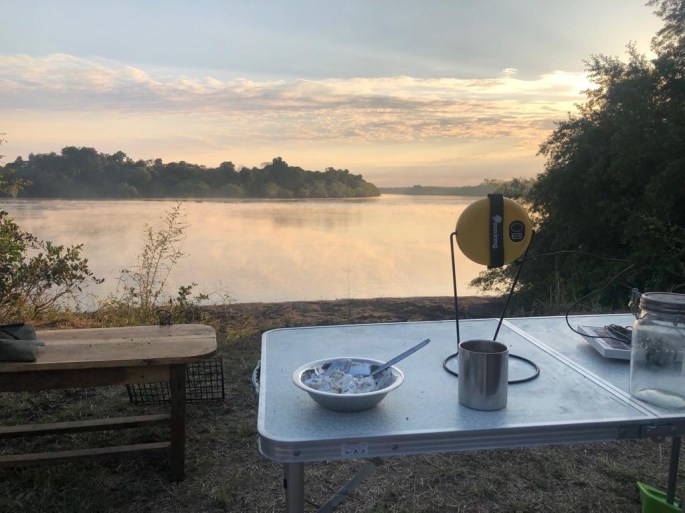
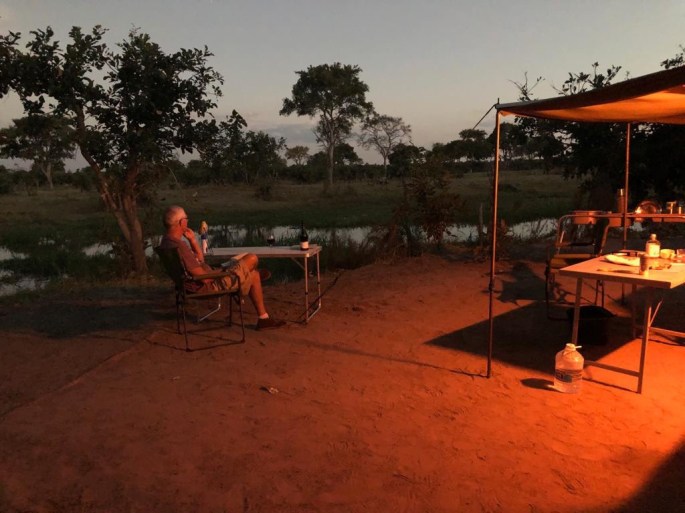
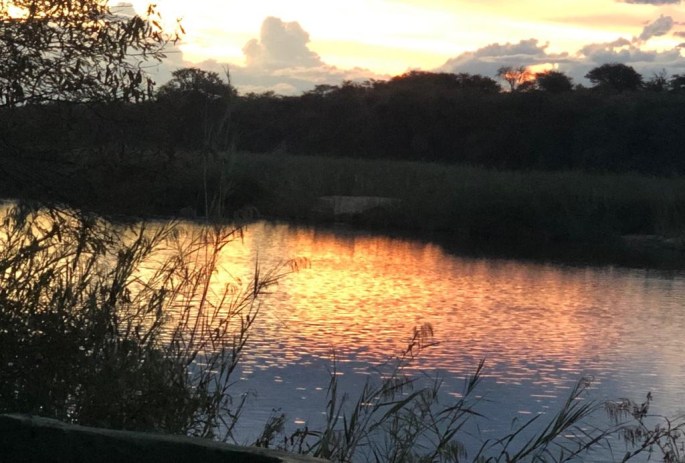
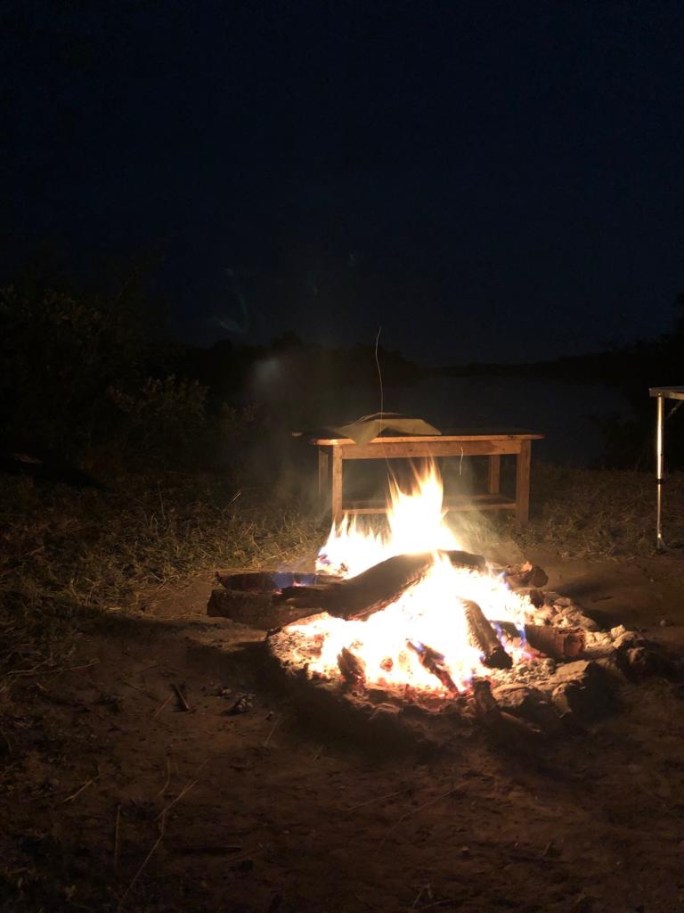
It was a wind-still night as we watched a full moon rise over the Kafue River. It was strangely quiet – only the distant rumbling of rapids and the territorial grunting of hippos. As we sat taking in the beauty of the moonlit river, we imagined the travails of the early explorers and wondered whether David Livingstone’s concerns were as pressing as ours: Would there be cold beer in the next village for example, and a clean toilet? What were the chances of finding ingredients for a green salad? Ah, the silliness of our conversations 🙂
Annoyingly, the road took its toll in more than one way. The caravan’s battery lurched out of its bracket at some point and we watched with some concern as we slowly ran out of power. The details are too frustrating and dull to relate, suffice to say that we had to spend hours of the little time we had in Kafue sorting out mechanical issues.

We shall be back, though.
Tiger Tiger, Burning Bite

Welcome to Zambia!

After a long and tedious border crossing, our first stopover in Zambia is at the beautiful Kabula Lodge. This is yet another gem of a place, set on the banks of the mighty Zambezi. And mighty it is!

The lodge is predominantly a fishing lodge en Anton ‘wou graag lyn natmaak’. So, a-fishin’ we did go! After an hour of not a single nibble, we were beginning to lose hope, but there was suddenly a hard yank on the line and the rod almost bent in half. There was a monster on the hook! Kennister, our guide, was yelling excitedly, “ Pull! Pull! It’s a big one!” After a bit of a fight, a 5kg tiger fish, with an impressive set of teeth, was reeled in.

Tiger Tiger, burning bite

In the river of great might

What immortal hand or eye

Did make thy fearful dentistry?

(With apologies to William Blake)

I took a quick photo and then urged Anton to throw the fish back into the river – both for the fish’s sake and ours. I had visions of those fangs clamping onto a limb – a burning bite indeed!

A Giant Welcome and a Sad Goodbye

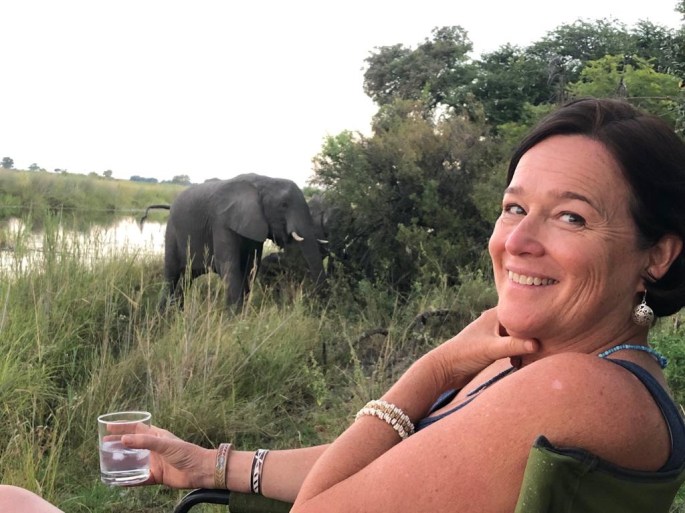
It was with a fair bit of trepidation that we braved that sandy river road to Nambwa again, but once again our efforts were rewarded. We had scarcely hammered in the last peg when the welcoming party arrived: a herd of about 7 elephants with two adorable little calves. When they arrived, I was standing on a little wooden deck at the water’s edge. Ahead of me and on both sides were elephants; behind me the crocodile and hippo filled Kwando River…To say that I was nervous is an understatement. I felt very small and vulnerable. I stood perfectly still and watched as they slurped up water and broke branches as they ate. The curious little ones explored the new terrain with their feet and trunks. They were completely unperturbed by our presence. Once they had eaten their fill, they moved on.

A little later: comfortably Nambwa

Set right on the banks of the river with its own little wooden deck, Nambwa takes top spot in our campsite rankings. It is covered in enormous sausage, camel thorn, knob thorn and jackalberry trees, which not only provide shade but also attract a multitude of birds. Some special sightings for me were: Hartlaub’s babblers, a rufous-bellied heron, a purple heron and exquisite white-fronted bee-eaters.

The hippos came to say goodbye on our last night, chomping and grunting loudly outside our caravan. It was a wrench to leave this little piece of paradise, but the journey continues.

Nambwa Campsite:

Setting and Ambience: 10/10

Amenities: 7/10

• Shared ablutions with hot showers

• Plugs available to charge appliances

• Pool

Hakusembe Campsite:

We stopped at Hakusembe Lodge, 15 km from Rundu, on our way to Nambwa. It has beautifully appointed campsites with great amenities.

Setting: 8/10

Amenities: 9/10

Highlights:

• Beautiful view of the Kavango River

• Amazing birdwatching

• Grass! What a pleasure to be able to get into bed without sandy feet!

• Clean, private ablutions.

Something New Under the San

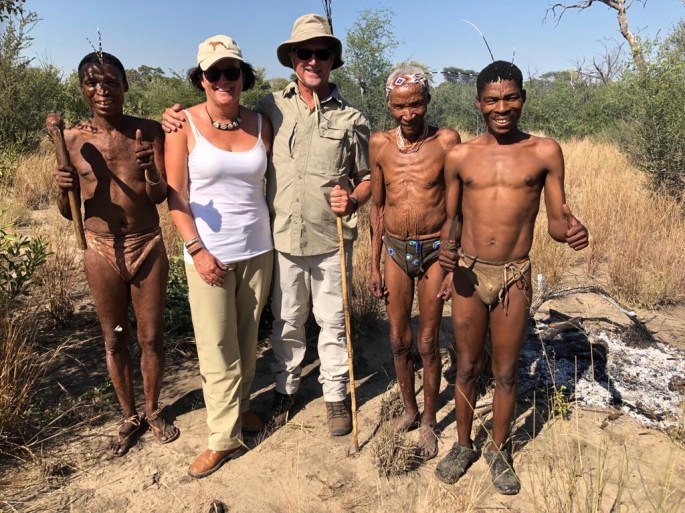
If we’d been looking for a unique experience, this was it. Our efforts to come all the way back to Nhoma safari camp from Grootfontein were rewarded: the 12 km bush walk with Ju/‘Hoansi San trackers from Nhoma village was truly fascinating.

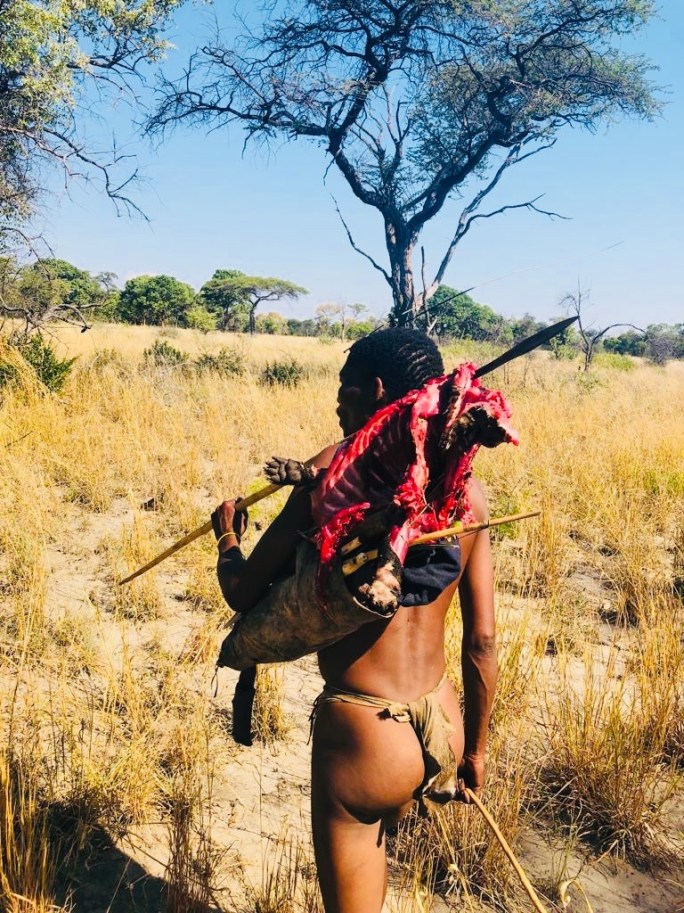
The trackers fetched us, all decked out in their loincloths for our benefit. (Yes, it wasn’t entirely authentic, but the hunting practices and use of medicinal plants are very much part of the day-to-day lives of these villagers.)

We set off at a relaxed pace, stopping to examine springbok, kudu and jackal spoor – and even fresh (one day old) leopard.

Outward bound
Leopard spoor

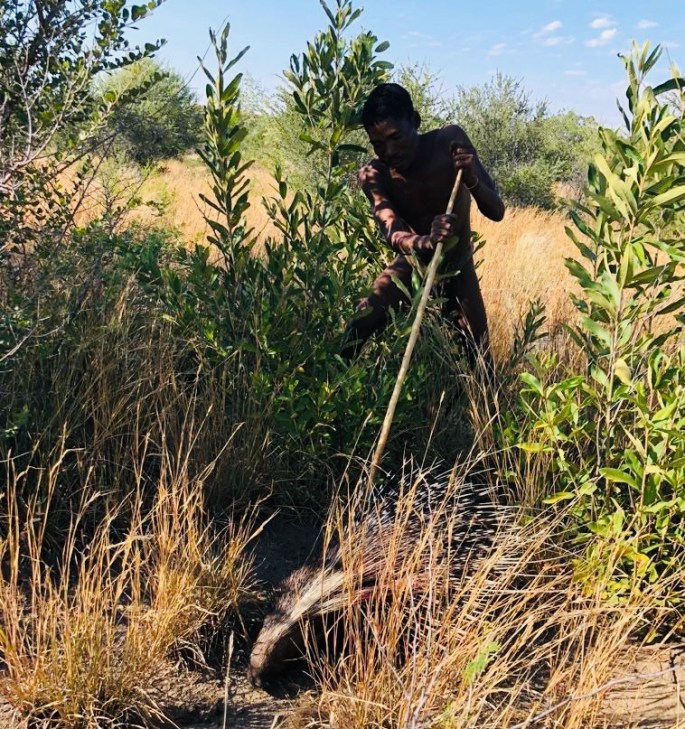
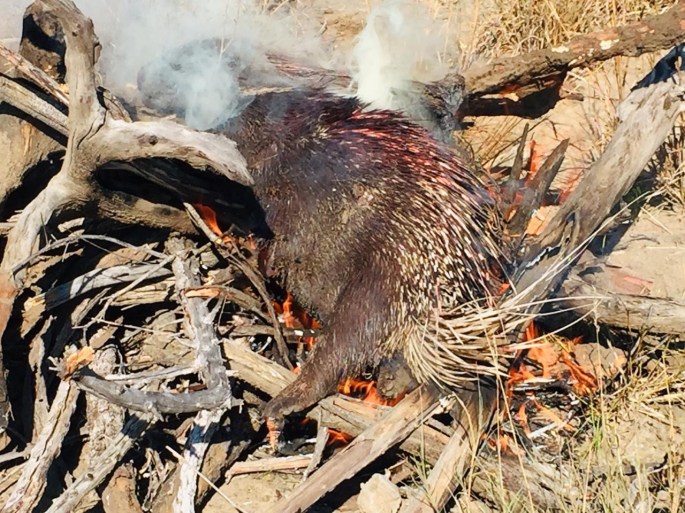
All at once the trackers came to a halt and conferred excitedly. They had found what they were looking for: porcupine spoor. The pace picked up as we wove this way and that through the brush, following the hapless creature. After about half an hour, we were motioned to stop. There, hiding in the shadows of a bush was the porcupine, quills aquiver. There was a flurry of movement as the porcupine broke cover, running the gauntlet to save its life. An assegai was raised, and I closed my eyes. In my mind I was saying, “Run, porcupine, run!” Although my eyes were closed, I could still hear the defensive rattling of quills and then rasping gasps as the porcupine took its last breaths. I have to admit, I was shaken. It was all a bit much for my dislocated Western sensibilities. I was used to pre-packed portions of meat that don’t resemble a living creature, for heaven’s sake

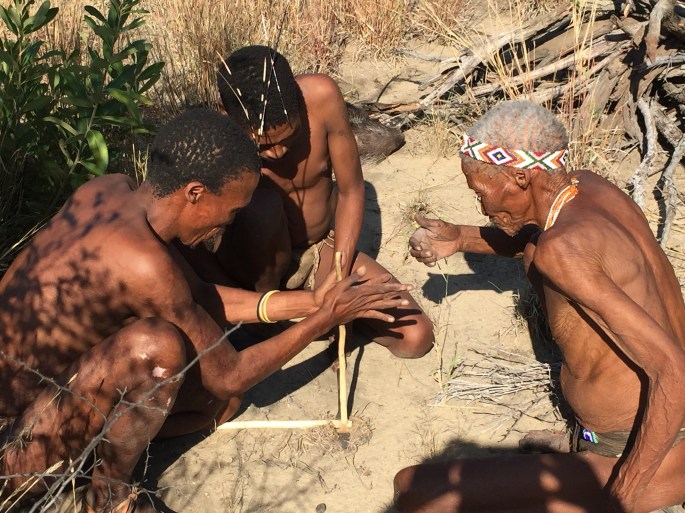
I watched in awe as an enormous pyre was built by rubbing two Mangetti sticks together.

The quills were harvested first. These are used to make jewellery. Then, the entire carcass was hurled onto the flames to burn away the hair.

Not sure Neil Diamond had this in mind when he penned his lyrics

Once the skin and liver had been cooked and eaten, the meat was divided among the hunters. Apart from the intestines, every part of the animal is eaten – true nose to tail eating. Anton sampled some braaied porcupine skin. My stomach turned at the thought.

With full tummies and food for the pot, the hunters were ready to head back.

Homeward bound

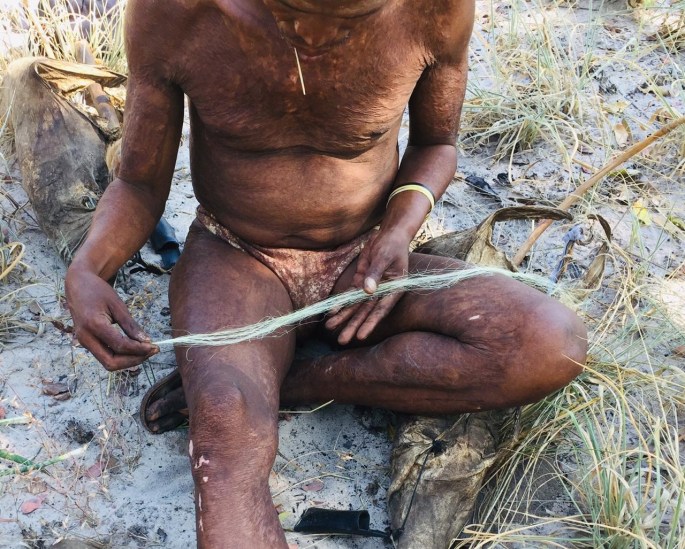
On our way back, they stopped to set a trap for guineafowl. To make the twine for the snare, fibres from the leaves of Mother-in law’s tongue were woven together:

I was amazed at how strong it was- easily as strong as twine bought at a hardware store

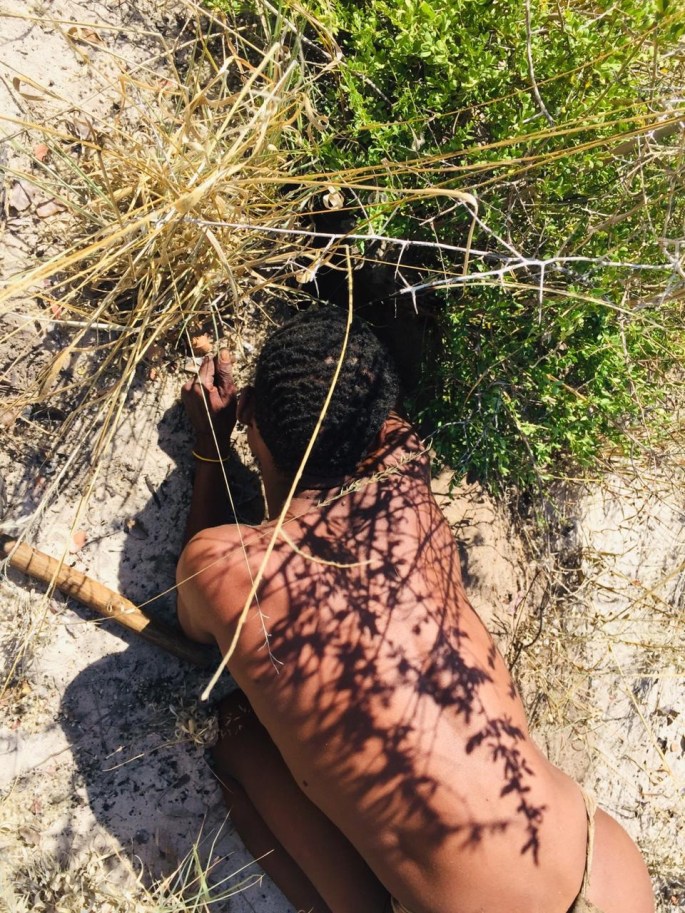
Violet tree roots are the bush equivalent of menthol or Vicks.

The root smells just like wacky wicks bubblegum

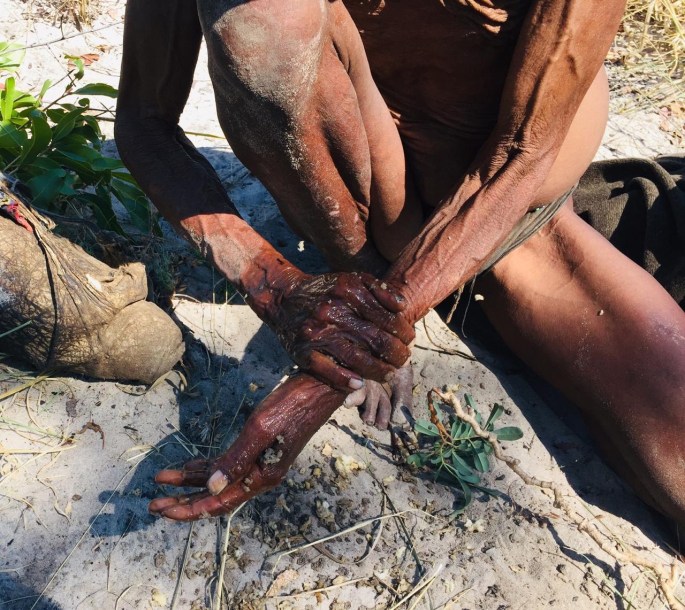
The liquid from the Kalahari ground tuber is used as a substitute for water:

Frans cleans the dust off his hands after digging out the tuber
Bitter but refreshing

We returned to our caravan. Anton took chops out of the freezer for supper, and I lit the gas stove for coffee. We wouldn’t survive long in the desert.

Tracking back

30 April – 6 May

Maun was a puncture (yes, another one) and provisions stop. We stayed at Audi campsite on the outskirts of town. At Audi, you get to know your fellow campers intimately. Parked cheek by jowl, much like a parking lot, we could hear our neighbours breathe, never mind anything else…no peace and tranquility there. And if it wasn’t Serge snoring in his rooftop tent, then it was the neighbourhood dogs yapping aimlessly all night. At 4am, when the barking finally subsided, a cacophony of hysterical roosters erupted, becoming hoarser and more discordant with each successive crow. Needless to say, we were very happy to make tracks after three days – the silence and remoteness of Otjozondjupa (formerly Bushmanland) was calling.

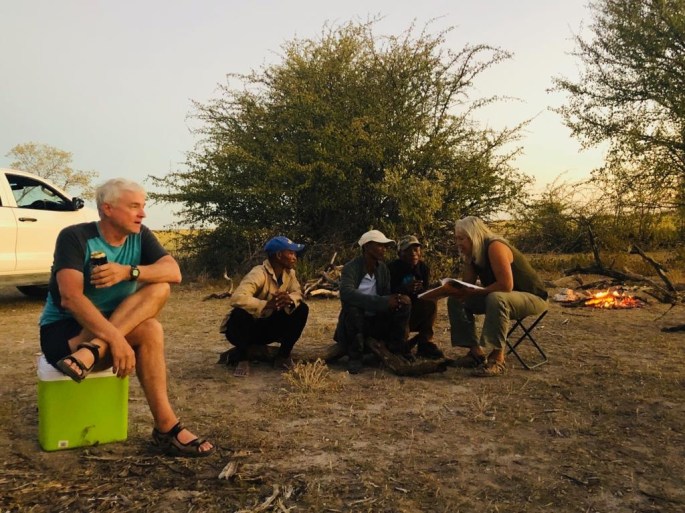
We met friends, Clive, Simon and Lezlie in Tsumkwe, a one-donkey town where unemployment, alcohol abuse and grinding poverty have taken their toll on the local population. Clive was there for business meetings with some San master trackers as well as to assist one of the trackers who has multiple drug resistant tuberculosis. Tsumkwe has the highest incidence of TB in the country. There is only one ‘hospital’ at nearby Mangetti, and one doctor- a retired Swiss doctor who cannot retire as there is no replacement for her. The conditions in the hospital are unsanitary, with broken toilets and little children sleeping with their desperately ill (and highly infectious) parents. It is a dire and very sad situation. A way out of these wretched socioeconomic conditions is for the San master trackers to be accredited as such, enabling them to earn a living by accompanying tourists on tracking expeditions, not only in Namibia, but parts of South Africa such as the Makuleke Concession within the Kruger National Park.

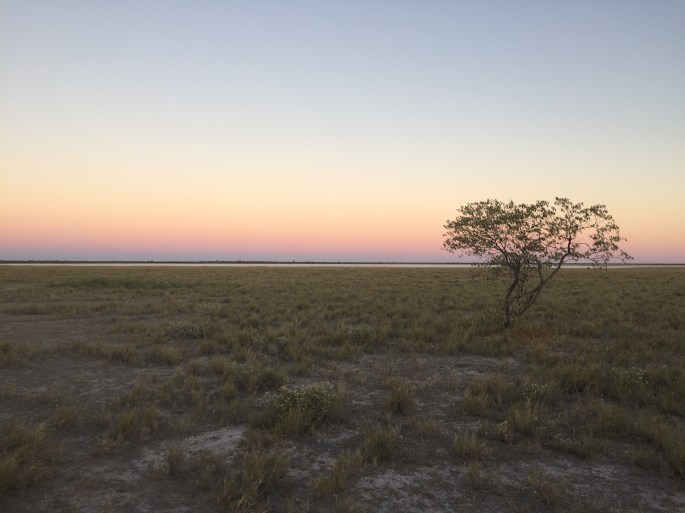
We were privileged to spend two nights wild camping on Nyae Pan with two of the master trackers. Sadly, the pan, which is usually full at his time of year, was bone dry. As a result, apart from spring hares and a couple of jackal, there was not much wildlife to be seen. It was beautiful nonetheless.

Sunset on Nyae Pan

Identifying spring hare spoor

Clive, Lezlie, /Ui David, /Ui Gideon and a junior tracker
Imagine this full of water, flushed pink with thousands of flamingos

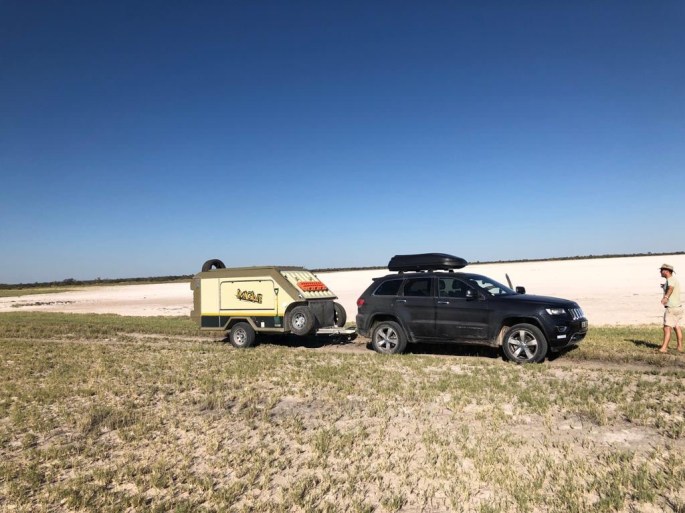
And then the wheel(s) fell off. Literally. On our way out of the pan en route to Nhoma, we heard a now familiar sound associated with malfunctioning wheels. Surely it couldn’t be another puncture. Was our karma that bad? Alas, it was worse than a puncture. When we got out of our car to investigate, one of the caravan’s wheels was hanging on by one nut and bolt – all the other nuts had fallen off along the way. Good thing we were going at 20km/h and not 120km/h or I may have been typing this in a hospital bed, or perhaps not at all. I walked back along the tracks and managed to salvage three nuts, but when I returned with my lucky find, I found Anton staring disconsolately at the wheel: two of the wheel studs had been sheared right off after 7000km of often horrendous roads. We managed to force three nuts onto the remaining threadbare studs, and we limped 280 km to Grootfontein to get it repaired.

‘You picked a fine time to leave me, loose wheel’

Close Encounters

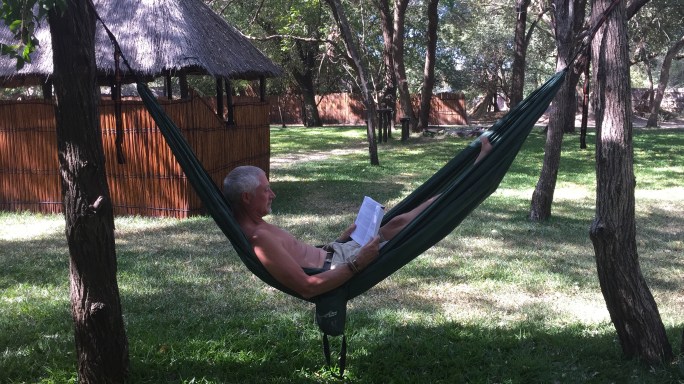
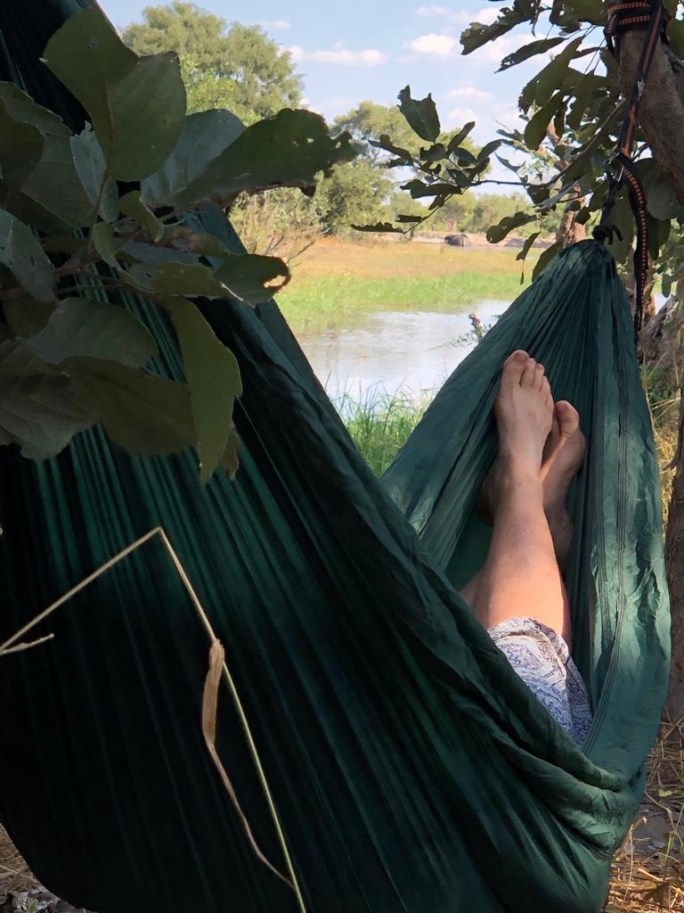
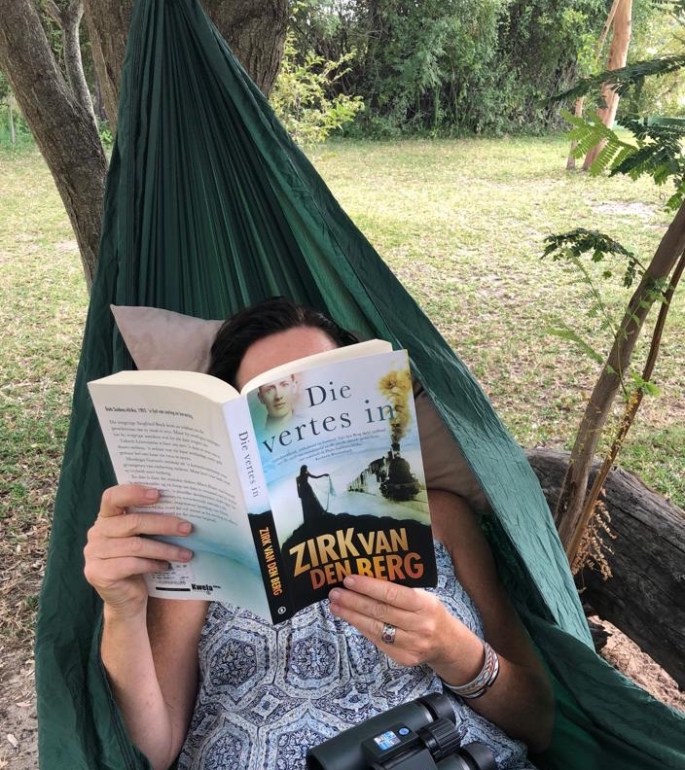
After Moremi, Dijara Community Camp was our next stop. There were no other campers, so we had the luxury of choosing our site. The one on the banks of the river with trees spaced perfectly for a hammock looked just right. With binoculars and book in hand, I set off for a relaxing afternoon of reading and birdwatching, suspended between two trees at the edge of the river.

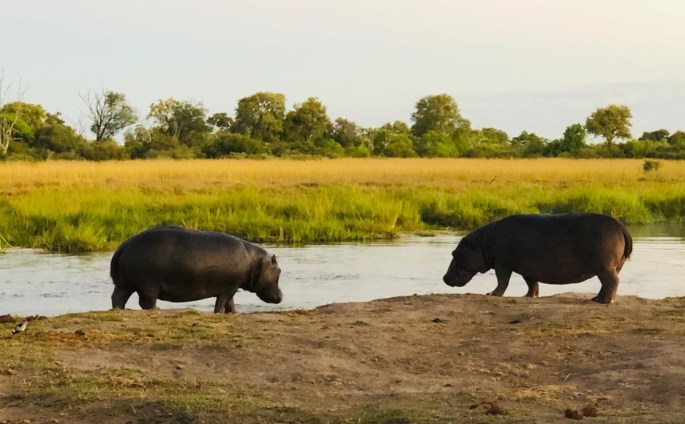
As I lay gazing lazily into the middle distance, I noticed little archipelagos of grass clumps drifting downstream. Little did I realise that these were harbingers of an imminent visitor…I glanced up from my book and saw two little round ears in the river a few metres away. I knew that they belied the enormous hulk that loomed beneath the surface, and I was out of that hammock in one movement. Not a chance was I getting caught between those chompers.

A short while later, as I gathered my wits in the relative safety of our caravan, Mr Grey lumbered across for a howdy-do. He broke a few branches around our site and then had a dust bath in the adjoining campsite. Goeie genugtig! We sure were communing with nature.

Dijara Camp

Setting: 10/10- especially as we were the only campers there

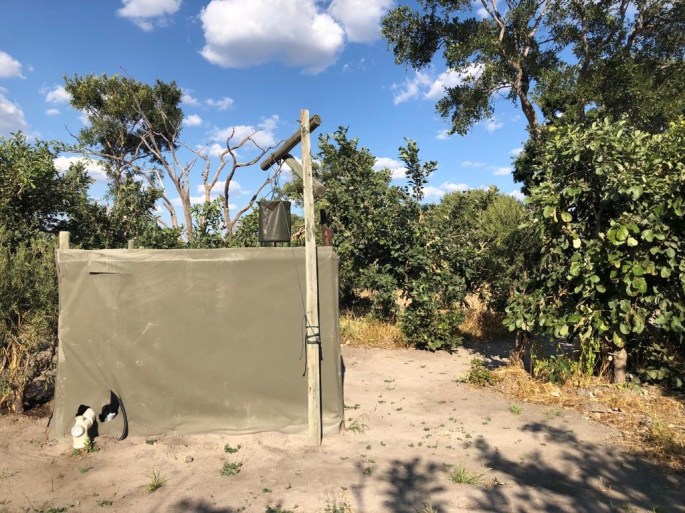
Amenities: basic- cold bucket showers, but they did the job well enough.
Bokspring to Moremi

Buckle up and hold on to your hat – we were in for one hell of a bumpy ride. These roads made the Namibian roads feel like the Autobahn by comparison.

Bridge over the River Khwai: our entry into Moremi

We were up before dawn to make the most of our short stay in Moremi. At the first glimmer of light, we set out. The fronds of the grass looked golden in the early morning light, and the vegetation was lush and fresh in the morning dew. I opened my window and breathed in the wild smell of the bush. Compared to South African game parks, Moremi is quite undeveloped. On the one hand, the lack of maps and road signs make navigation frustrating; on the other, though, it has something pure and unsullied by human intervention about it.
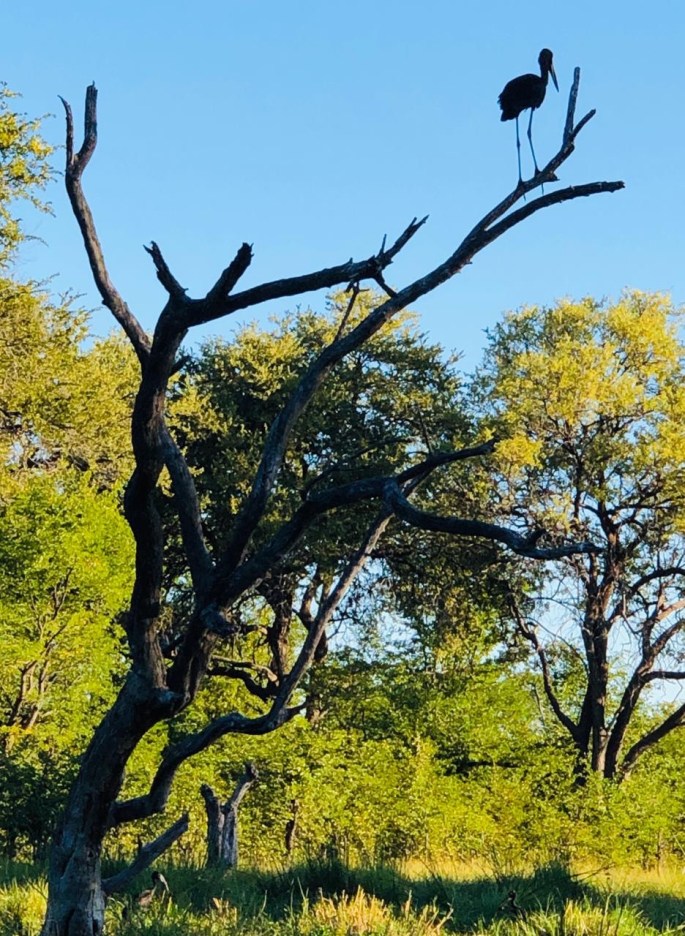
The first clue that we were going to see something special was a little jackal that trotted past, licking his chops and looking quite pleased with life. Above us, vultures were wheeling. And then, a few metres ahead of us, we a saw a yellow mane and what looked like a buffalo’s horn: lions were feeding. Never mind the vultures wheeling, I was reeling…from the schtunk. Pheeew! It was rank. As we sipped our morning coffee (with the window closed), we watched the sun rise on a magnificent bush scenario. In the distance was the aggrieved huu -hu-hu-hu of a hippo and the cries of fish eagles; right in front of us, lions tore away at a buffalo carcass while the vultures, aging and stooped, their bald pates darkened, patiently waited their turn.

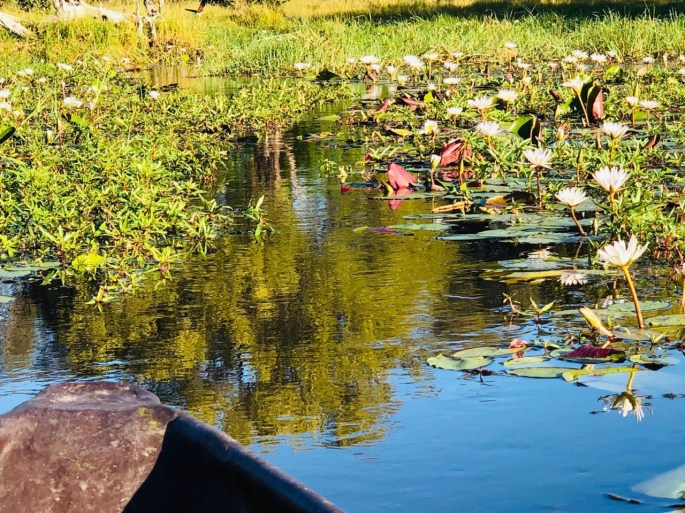
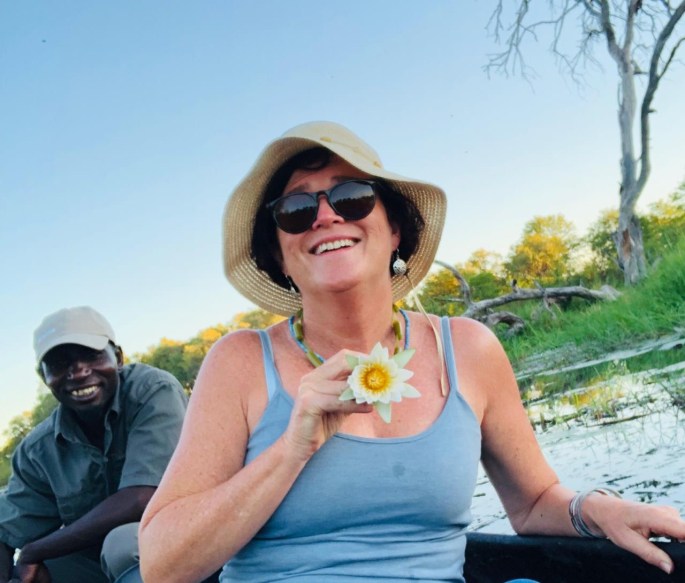
A Mokoro trip at sunset was the perfect way to end the day. The silent, gliding motion of the mokoro through the water lilies, with the cool evening air on our skins, was a panacea for our jolt-and-bump-weary bodies.

Loopy de Loop

Ngoma border post was a quiet and easy entry into Botswana. This was the beginning of our 2000km loop through Botswana and then back through Namibia to Nambwa again. Why, for heaven’s sake , would we do this? The short answer is- to take up the opportunity of what promises to be a unique experience: joining San master trackers in the Nyae Nyae Conservancy in the Otjozondjupa region, Namibia. This has been made possible by an invitation from Clive Thompson, Anton’s ex-colleague, with whom we did a memorable guided walk in Pafuri two years ago.

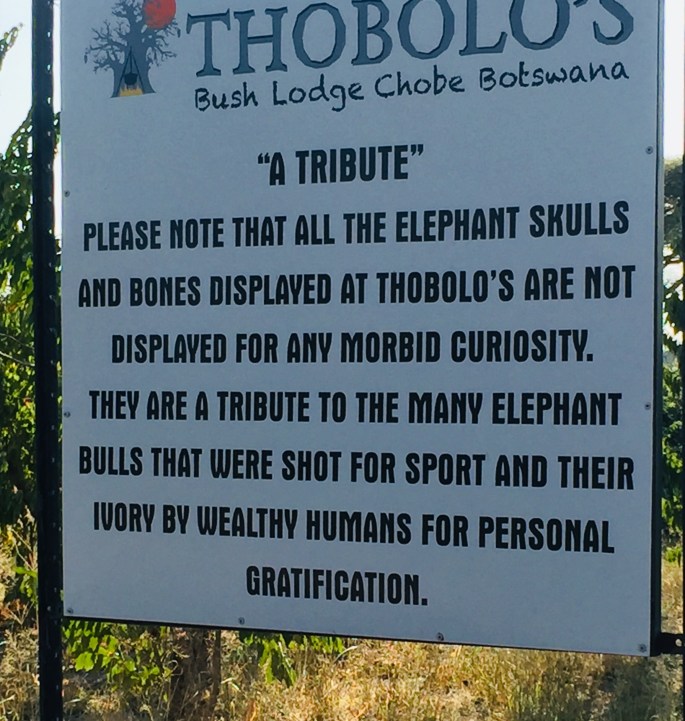
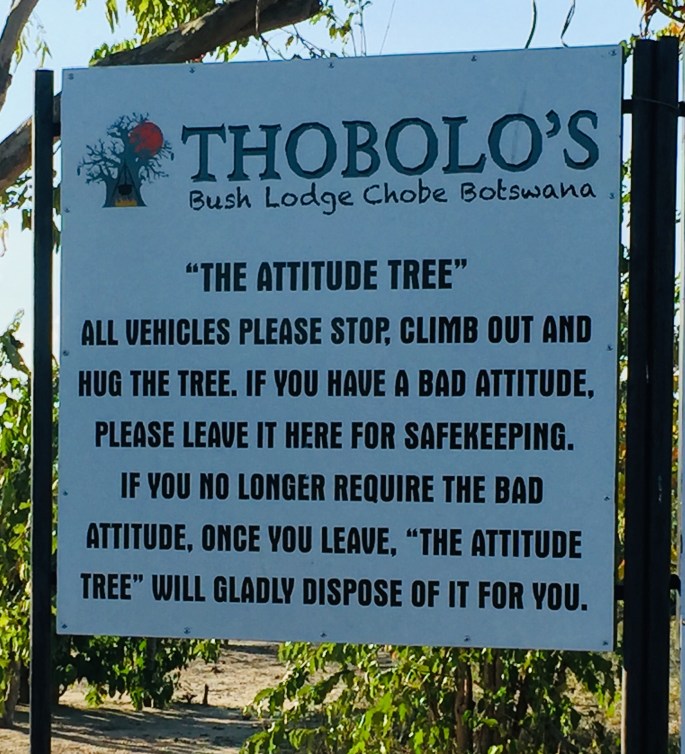
After an extremely sandy and hair-raising drive, with the trauma of the Nambwa extrication fresh in my memory, we arrived with great relief at Thobolo’s Camp. This is an ecotourism destination, and I appreciated both their humour and what they stand for.

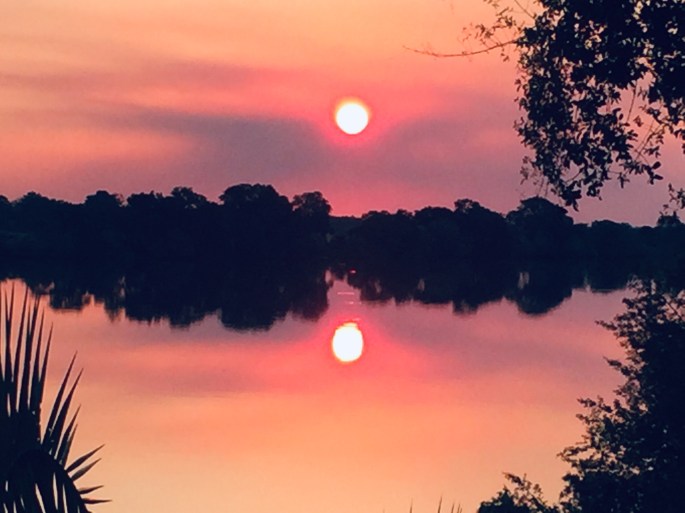
We celebrated Anton’s birthday on the 25th with a beautiful African sunset and a delicious steak at the lodge.

Thobolo’s Camp:

Setting: If you are fortunate enough to get campsite A10, the shade and proximity to the waterhole would warrant an 8/10 score. However, most of the sites don’t have much protection from the baking sun, nor do they have much of view. So, on average, the score we would give is 6/10.

Amenities: Use of the lodge’s facilities and shared ablutions : 6.5/10.

Drawback: Homo Sapiens: our stay coincided with the Namibian school holidays. Enough said.

Travel tips:

If you cross into Botswana via Ngoma, make sure that you have:

1.Pula – there is nowhere either to exchange or withdraw money other than Kasane (way off-route) or Maun.

2.Petrol – there are no fuel stations either. This could limit your game viewing in Moremi significantly.

Thankfully, we had fuel reserves in jerry cans

There are no shops except for the odd spaza shop, so stock up beforehand. No red meat may be taken over the border, however. We also had to relinquish fresh fruit and vegetables.

All’s Well That Ends Well

We had been so looking forward to camping on the banks of the Kwando River at Nambwa camp. Stew and Gill’s time there had sounded magical. If only the officials at Bwabwata National Park had warned us about the roads…

Very much like Robert Frost’s dilemma (with a few African adaptations):

Two roads diverged into a riverbed

And sorry we could not travel both,

And be one traveller, long we stood

And looked down one as far as we could

To where it bent along the river;

Then took the other, just as fair…

… which turned out to be a foolhardy decision.

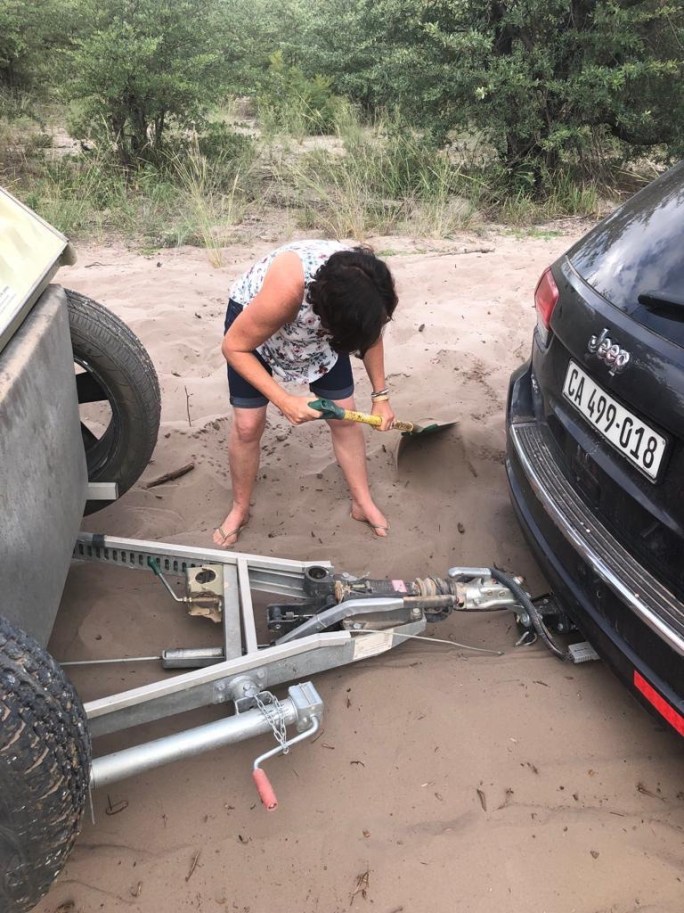
Now this was a road worth approaching with caution and reservation. As we progressed further along the riverbed, the sand got deeper, the swerves more frantic and the chances of getting stuck an ever-growing reality. And then there was a dull thud as the undercarriage came to rest snugly on the middelmannetjie (although the diminutive is inappropriate in this instance). We looked at each other with big eyes. Wat nou?

We shifted into self-help gear: Anton got the Maxtrax; I wielded the spade.

Anton engaged low range and put foot. No go…just an alarming grinding sound and a shower of sand as the wheels whirred us ever deeper into the mire.

Plan B: phone a friend. This was starting to feel familiar. However, the lack of phone signal made that idea redundant. Thank heavens for our nifty little WiFi gadget that we had bought in Swakopmund. An emergency WhatsApp call was made to Marion: the old ballies were stuck again. She phoned head office in Windhoek who organised a rescue mission from the camp. It would take a while, we were told.

We decided to make the best of our situation and poured a G&T.

About an hour later, we heard the rumble of an engine. Hooray! Help was at hand.

Furious digging ensued…

…and the snatch strap was attached to the Land Cruiser…

…and we were in business. Maybe we’d see the sunset from our camp after all.

Except…the rescue vehicle also go stuck.

And the clouds were gathering.

May Day, May Day – two vehicles down in the riverbed. The feedback was basically: suck it up. The other vehicles were all out on game drives. So, there we sat. And sat. And sat. The sun set and night set in.

Escaping our grounded reality in the pages of a book

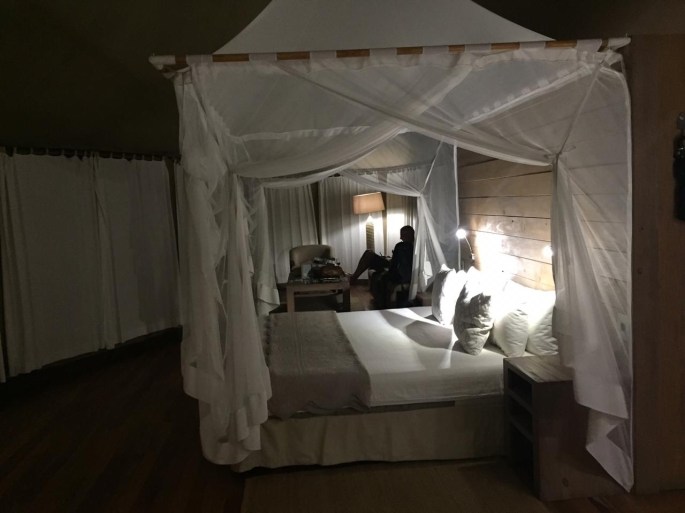
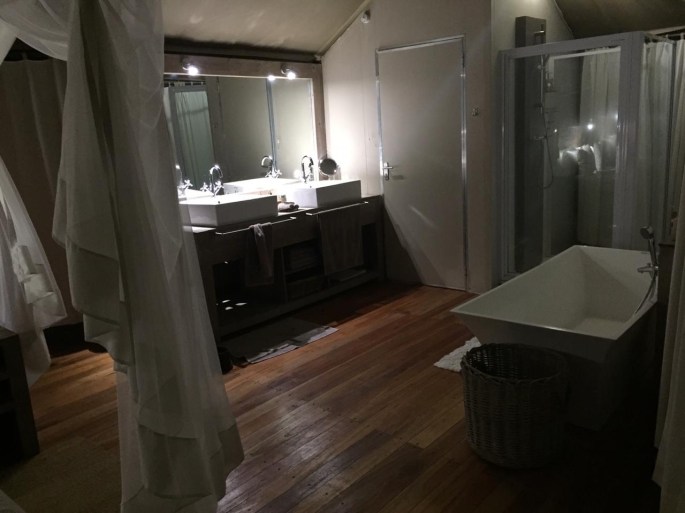
Eventually, at 7.30, more help arrived. A decision was made to pursue the rescue operation in the light of day, so we were plucked out of our sandy hollow and deposited into tented nirvana:

That night, as I snuggled into the Egyptian cotton linen, Anton at my side and the sound of the scops owl my lullaby, I counted my many blessings.

We woke to a magnificent view of the Kwando river and the surrounding plains. The second rescue attempt was successful, and we were soon on our way. This time we took the road more travelled, and that made all the difference.

Kunene to Kavango

We are now at Samitu Camp, idyllically situated on the banks of the Kavango River. My hammock is slung in the cool shade of a huilboom (African wattle). There is a bird party happening in the tree canopy which spans the campsite. The grey loeries have maintained their post the entire day, looking down on us, heads cocked with suspicion. The swamp boubous’ duet is interrupted by the jabbering of a garrulous gang of reed warblers and the high-pitched pieew of an African grey hornbill. In the distance, I can hear the squeals of Angolan children playing in the pools of the Kavango river, and the occasional bleating of goats. I could not feel more at peace.

An apt and beautifully written book, set in German South West Africa in 1905 ‘in ‘n tyd van oorlog en beroering’.

Attempting to identify the late avian visitors in the reeds

Samsitu Camp

Setting: 9/10

Facilities: 7/10

Highlights: sunsets, birds, having the camp to ourselves

Drawback: Day trippers…ay, there’s the rub. Loud partying and music at the adjacent bar was unpleasant for a couple of hours on our first evening. The second day and night were blissfully quiet.