The threat of a deluge turned out to be all sound and fury: there was a light sprinkling of rain – just enough to make that earthy smell of rain on dry earth. As for the Kunene River road…all that angst turned out to be much ado about nothing. Apart from a few rocky inclines and sandy river crossings, it was pretty much a standard 4×4 road – even pulling a caravan. Perhaps we were lucky, or maybe the skills of the driver played a role. 🙂 I would say that our passage was slowed more by livestock crossing than by river crossings
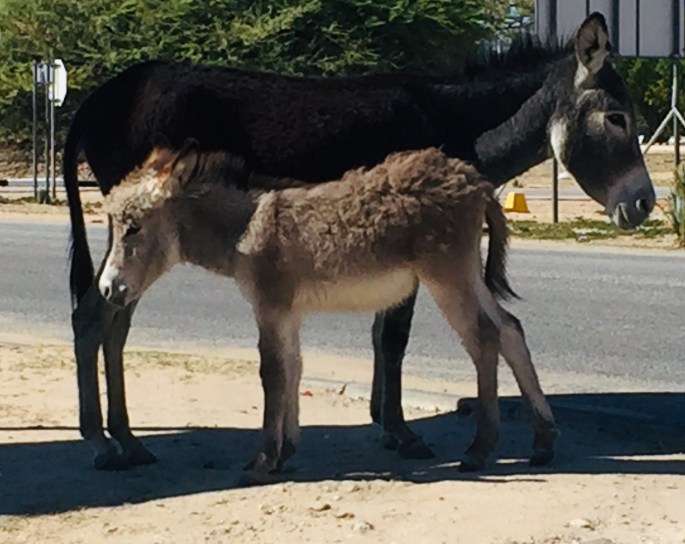
We saw dozens and dozens of donkeys en route, of which only two were being used as the proverbial beasts of burden. Life looks good for donkeys here.
It took us just under three hours to reach Kunene River Lodge where we camped for the night. And just when we thought our water consumption was no longer an issue, who should arrive to check on us…
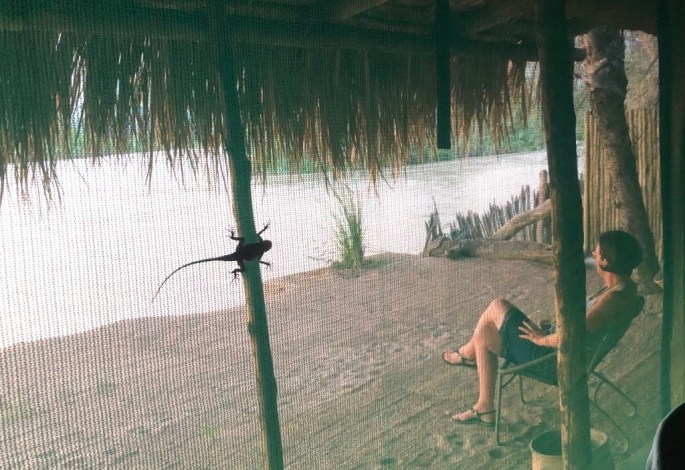
…a water monitor. 🙂
Kunene River Lodge
Setting: 8/10
Facilities: 7/10
Drawback: The sites are close together so it can feel a bit crowded- especially on the Easter weekend.
There are very few camps between Kunene River Lodge and Rundu, so we decided to push through to Rundu. It was a long 10 hour haul, mostly along the C43 and 45, so not particularly scenic. The names of some of the shebeens provided some entertainment, though:
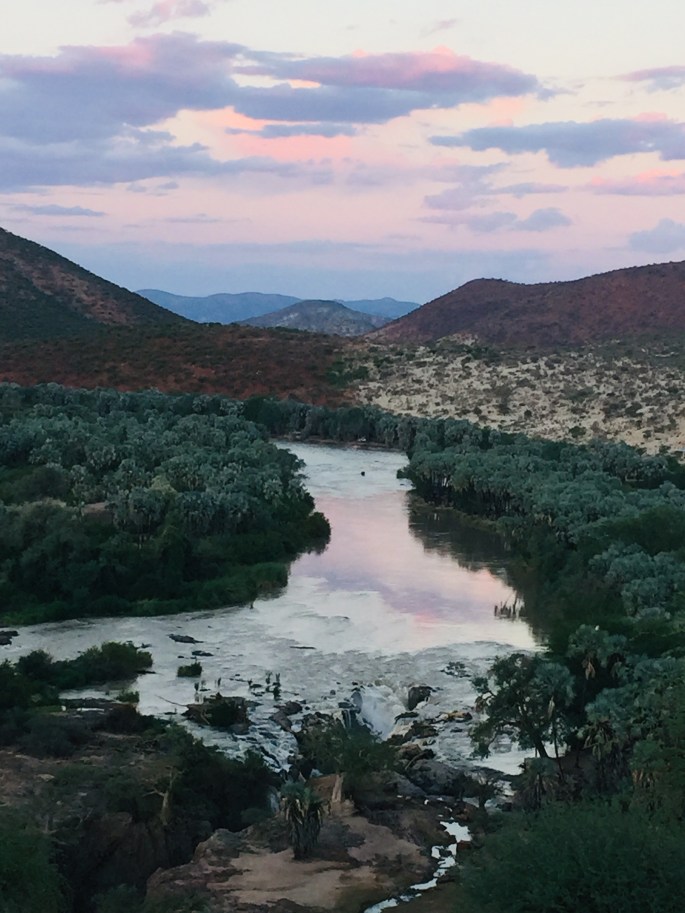
Just when I thought Namibia could not get any more exquisite, we arrived at Epupa Falls.
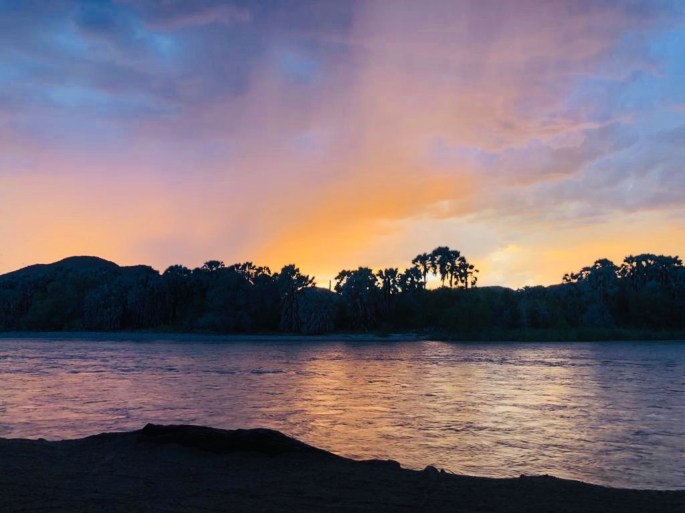
Situated on the Kunene River, Epupa camp shelters amongst the masses of palm and fig trees which line its banks. We are lucky enough to be the guests of friends and owners of Epupa Camp, Wouter and Marlien Van Zyl.
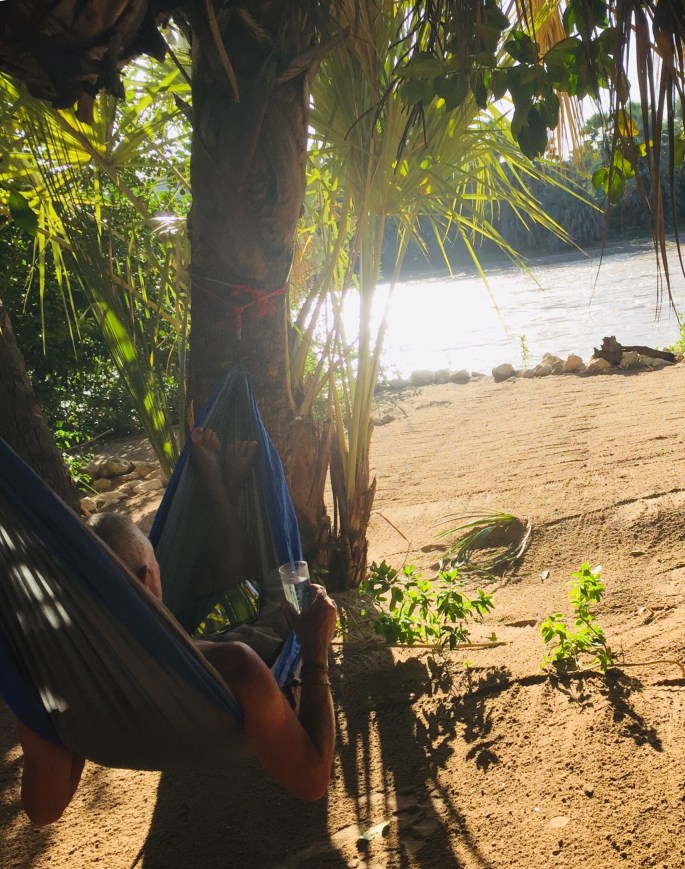
Cheers! View across the Kunene and into Angola
Marlien en Wouter -baie dankie vir jul gasvryheid! Dit is die absolute hoogtepunt van ‘n trip vol hoogtepunte tot dusver!
The heat persists! We use the butterometer to gauge the temperature. On Wednesday night at 7.45pm, it took 5 minutes for the butter to change from firm, cool curls of butter to a little yellow puddle. Last night, it was a little cooler: the butter still had some form by the end of our meal.
and cooling off in the river is clearly not an option
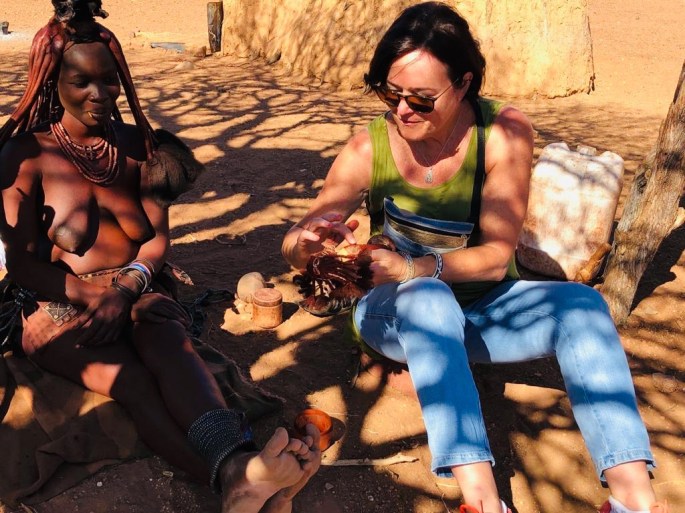
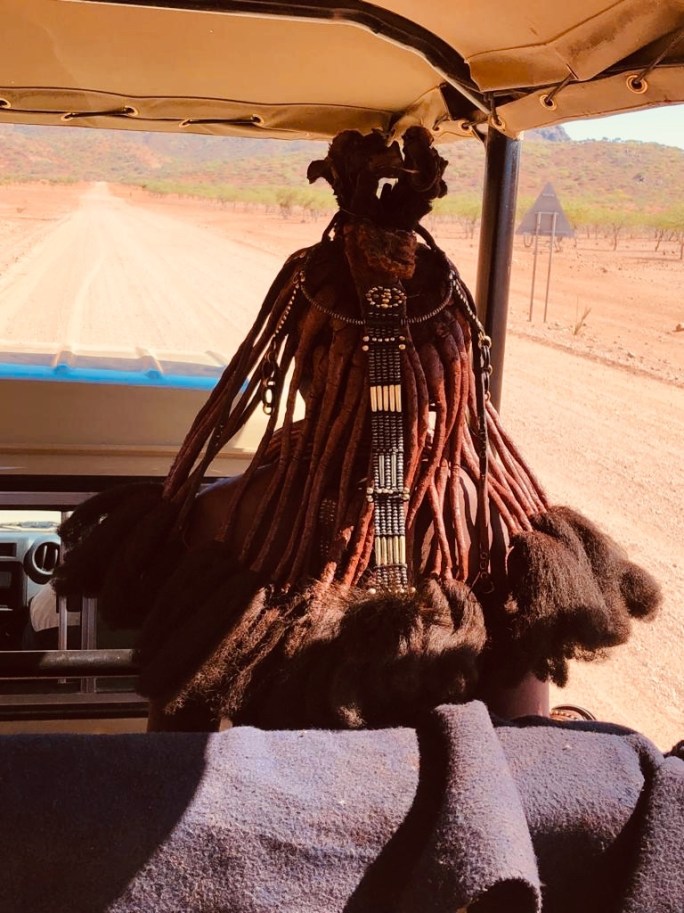
We visited nearby Himba villages yesterday which was a fascinating experience.
I tried my hand at painting with ochre. I also smoothed some on my skin. It looked very much like some of my unfortunate teenage experiments with fake tan.
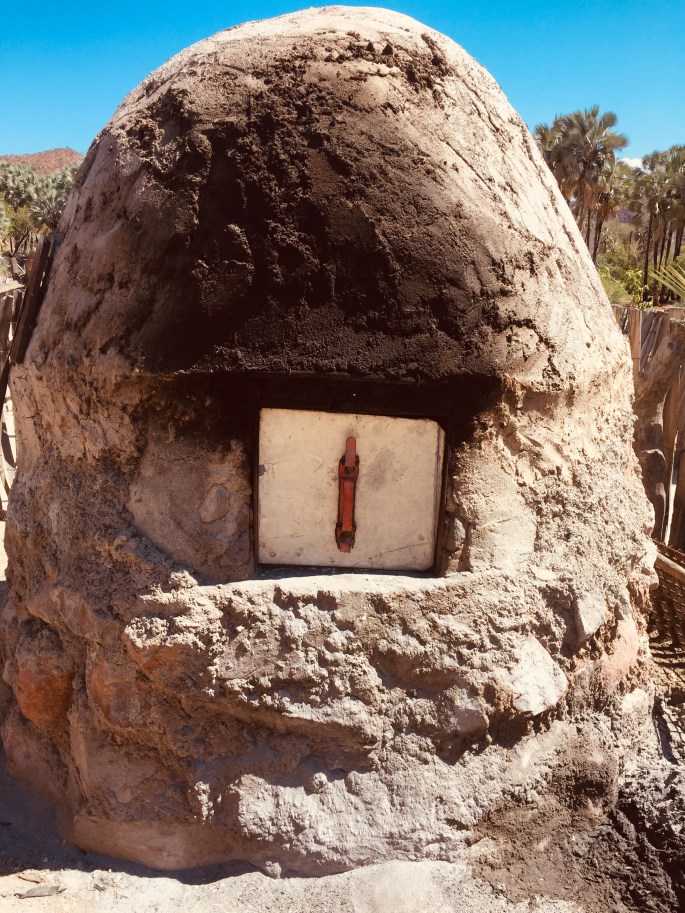
Tradition meets modernity
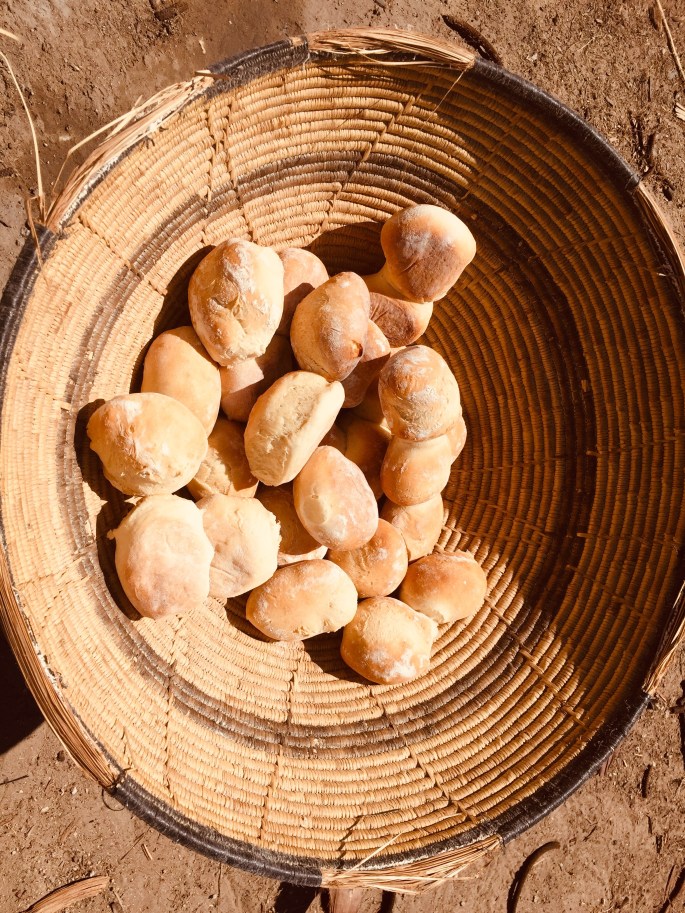
Anyone for freshly baked, crispy rolls?
Scrumptious
As I type, I can hear rumbles of thunder as dark clouds gather to the east. Anton is out cycling – best he makes haste! Rain will bring welcome relief from the heat and dust. Maybe we will have a cooler night’s sleep tonight.
Watching the storm roll in
Tomorrow we leave for Kunene River Lodge. We have heard varying reports about the condition of the scenic but more challenging 4×4 road along the Kunene, and whether it’s advisable to attempt it pulling a caravan. And what about the rain? Will it wash the road away?
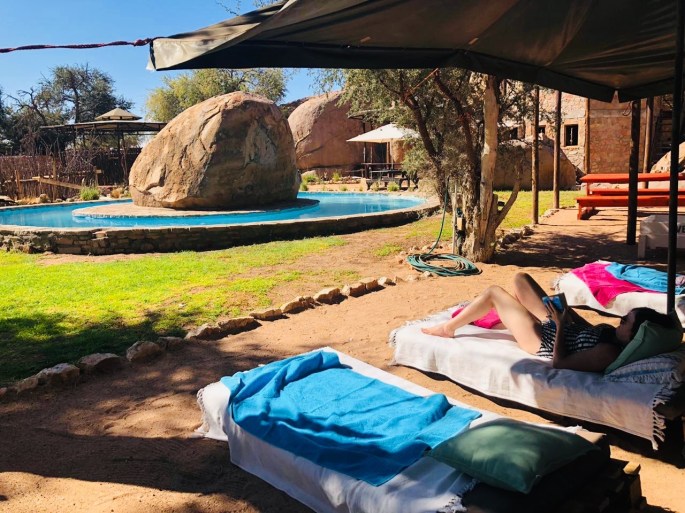
There seems to be a direct correlation between distance from the ocean and air temperature. Our next stopover was at Khowarib Lodge, some 40km south of Sesfontein, and man, was it hot. We pulled into our campsite, set up camp in super-quick time and whipped on our cozzies. We had to cool down – fast!
The pool area was grassed and surrounded by acacia trees teeming with bird life. Reading, blogging, napping and watching the birds, we spent all afternoon at this heavenly oasis.
White- browed sparrow-weaver
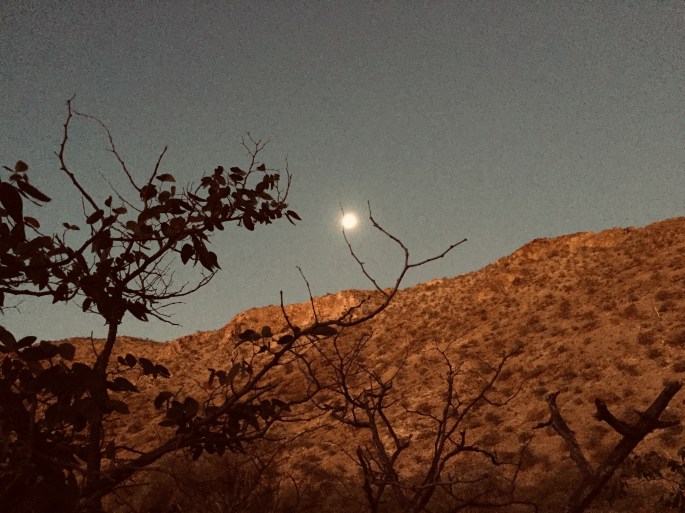
As the sun dipped westward, we made our way back to camp and watched the moon rise over the Hoanib River.
Travel Info:
Palmwag Lodge to Khowarib Lodge:
Distance: approximately 70km
Time: 1 hour
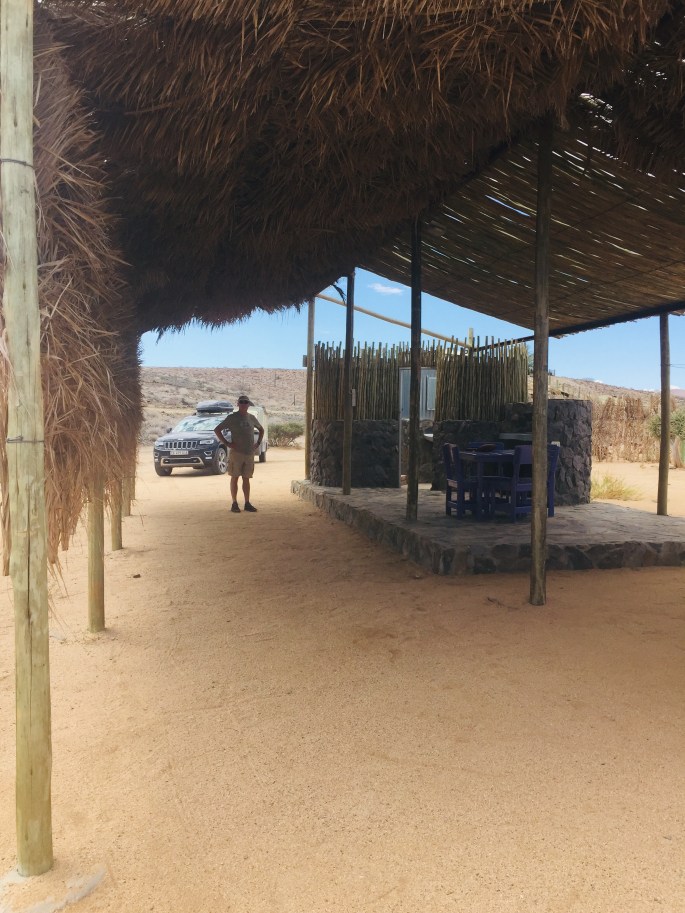
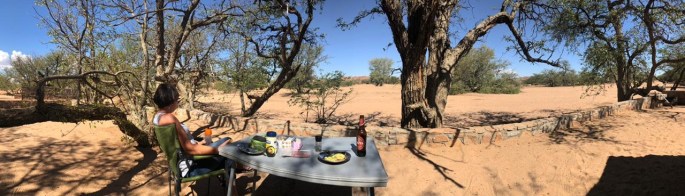
Khowarib Lodge Campsite:
Facilities and comfort: 6.5/10 (Broken toilet, electricity stopped working at our site- but beautiful pool!)
Ambience: 8/10 (if you get a riverside site) otherwise 6.5/10.
The road from Swakopmund to Uis was gloriously free of corrugations and ruts. Relatively speaking, it was like being in a hovercraft. We watched the landscape change as we drove deeper into Kaokoland: instead of the red sand dunes of the Kalahari and Namib-Naukluft, rocky koppies dotted the landscape. Volcanic activity aeons ago makes the region rich in gemstones, and hawkers try to eke out an existence selling these to travellers passing through. The closure of the tin mines has left many people living on the bread line.
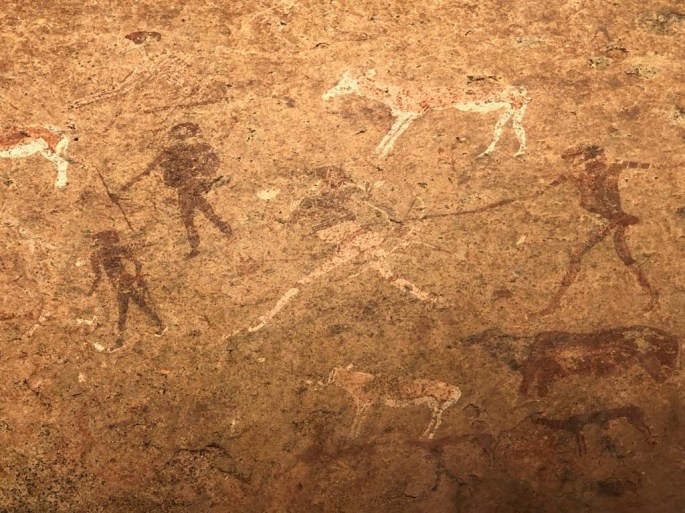
Kaokoland is also rich in ancient San rock art, so much so that Twyfelfontein was declared Namibia’s first World Heritage Site in recognition of the proliferation and quality of the paintings and petroglyphs found there.
We also went to see the famous ‘White Lady’ painting near Brandberg.
White Lady. Interestingly, neither female nor white as it turns out. This was actually a shaman, or medicine man. While pounding the sand in a dancing ritual, he raised clouds of dust which coated his body, turning it white.
It is compulsory to go on a guided tour – you cannot view the art on your own. The tour is worthwhile, though, and the tour guides are good. On one of the tours, we had the dubious fortune of having fellow visitor, Oscar the Omniscient, from the UK, with us. He was a font of information and generously and confidently shared his knowledge, often second guessing the guide (in a polite but slightly patronising way) saying things like, “Well, my understanding is that…” and “Well, actually, it’s…”
He made me think of one of my favourite poemsD.H Lawrence poems, The English are So Nice.
The English are so nice
so awfully nice
they are the nicest people in the world.
And what’s more, they’re very nice about being nice
about your being nice as well!
If you’re not nice they soon make you feel it.
Americans and French and Germans and so on
they’re all very well
but they’re not really nice, you know.
They’re not nice in our sense of the word, are they now?
That’s why one doesn’t have to take them seriously.
We must be nice to them, of course,
of course, naturally.
But it doesn’t really matter what you say to them,
they don’t really understand
you can just say anything to them:
be nice, you know, just nice
but you must never take them seriously, they wouldn’t understand,
just be nice, you know! Oh, fairly nice,
not too nice of course, they take advantage
but nice enough, just nice enough
to let them feel they’re not quite as nice as they might be.
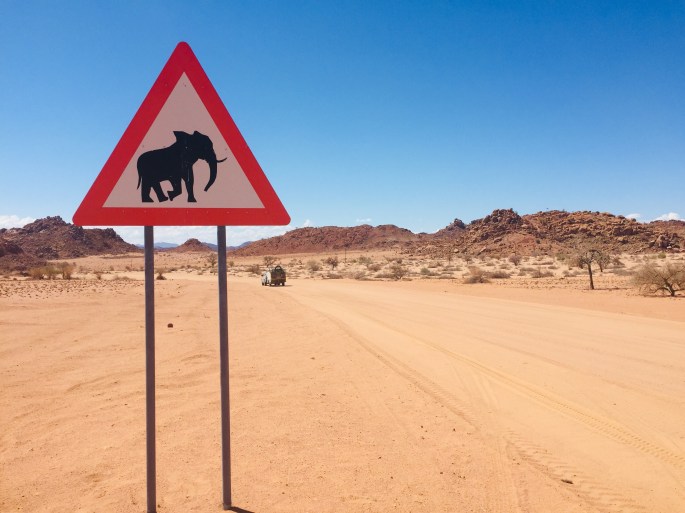
This part of Namibia is also the home of the desert elephant. We have not yet seen these elusive giants, but fingers crossed! ( I suggested calling them on an elliephone. Anton thought a trunk call would be better.)
Once again, the campsites did not disappoint.
Shaded sites with open air ablutions: perfect for stargazing!
Banana, honey and almond smoothie: a most pleasant find!
And on to Madisa Lodge campsite:
Loo with a viewAnother beautifully refreshing pool
Tonight we stay at the Palmwag lodge and then on to Sesfontein tomorrow.
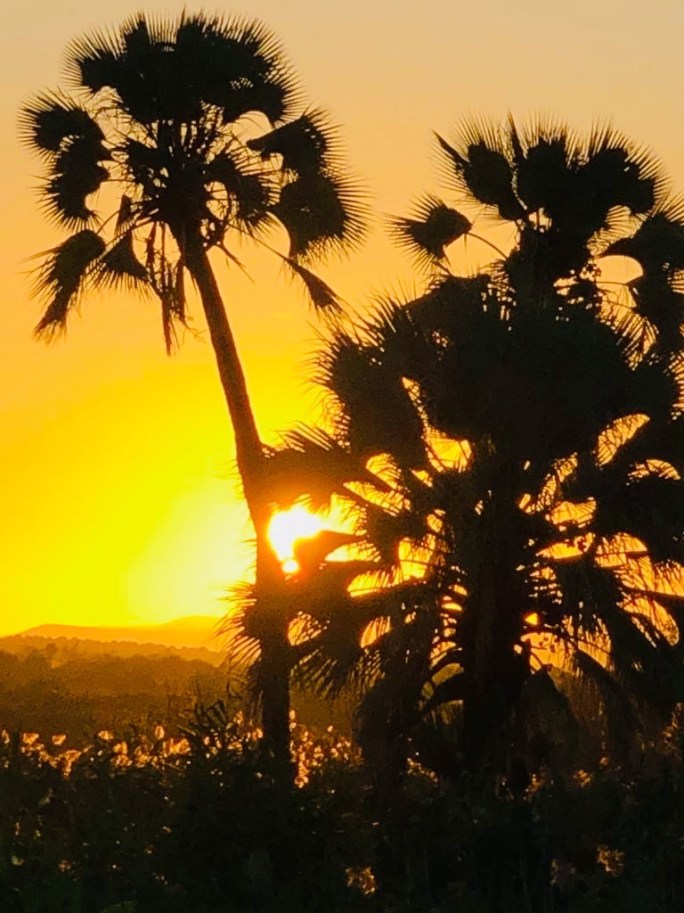
Sunset at Palmwag
Travel Info:
1.Sesriem to Swakopmund
Road: Very corrugated with a good chance of a puncture. We also passed an accident where foreigners lost control of their car.
Anticipated time: 6 hours
Actual time: 8 hours (including the puncture)
Stopover in Swakopmund: Alte Brucke
Convenience and facilities: 10/10
Ambience: 2/10
2.Swakopmund to Uis
Road: Beautiful dirt road. Smooth as silk.
Stopover: Dareb Isib campsite
Comfort and facilities: 9/10
Ambience: 7.5/10
Tour to see White Lady rock art:
• 50km NW of Uis
• Last tour leaves at 4pm
• N$ 80 pp
• Cash only – no credit card facilities
• Worthwhile
3.Uis to Madisa Lodge
Road: corrugated
Time: 2.5hours
Camping facilities:
Facilities and comfort: 8/10 (stunning pool!)
Ambience: 9/10
4.Madisa Lodge to Palmwag Lodge via Twyfelfontein
Time: 2.5 hours excluding tour at Twyfelfontein
Tour of petroglyphs at World Heritage Site in Twyfelfontein
• Cash only
• N$ 80 pp
• Highly recommended
Tip: Fill up with petrol as you enter the conservancy – there is no fuel available for quite a distance after that.
Stopover: Palmwag Lodge campsite
Camping facilities: 7/10
Ambience: 6/10
Rhino tracking and game drives available – at a price. (N$ 2300 and N$800, respectively.)
After the puncture episode in the searing heat, Swakopmund’s chilly temperature (14 degrees) was a welcome reprieve. It was mainly a reparations stop -for the car, the caravan and the constitution. All that shake, rattle – and thankfully not roll- took its toll on us all. We treated ourselves to a delicious meal at The Jetty restaurant, beautifully set at the end of the jetty, surrounded by the ocean on all sides.
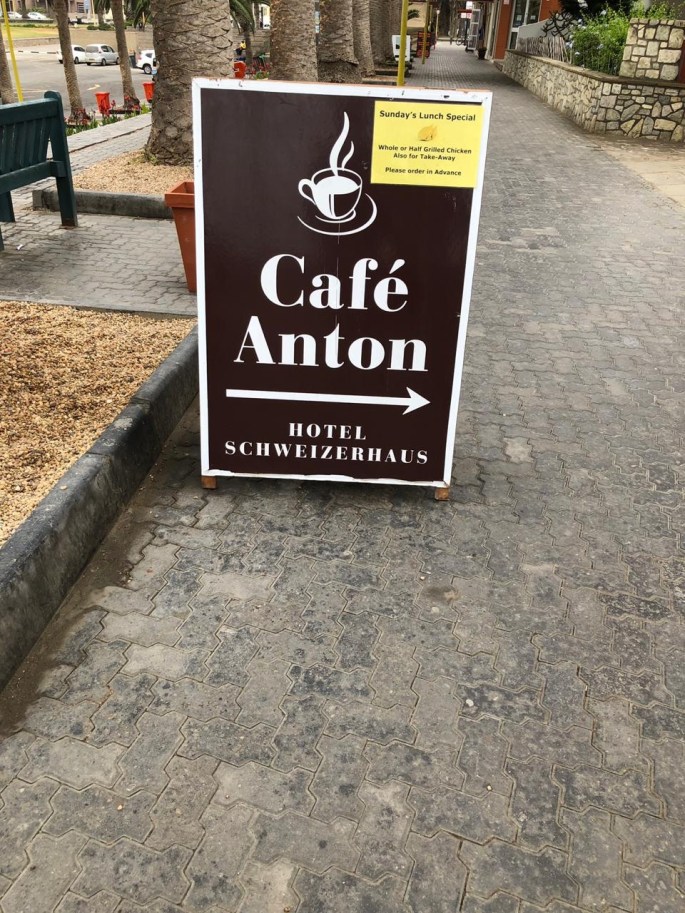
Of course we had to visit Cafe Anton for coffee and…
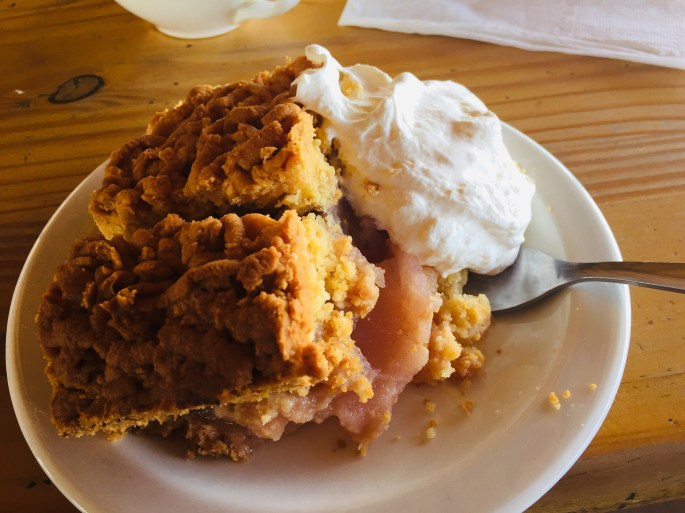
Apfelstrudel: desert dessert, it seems!
We left Swakop shivering in our boots and jackets. 5 hours later we were baking at 35+ degrees – a mere 20 odd degree difference in temperature.
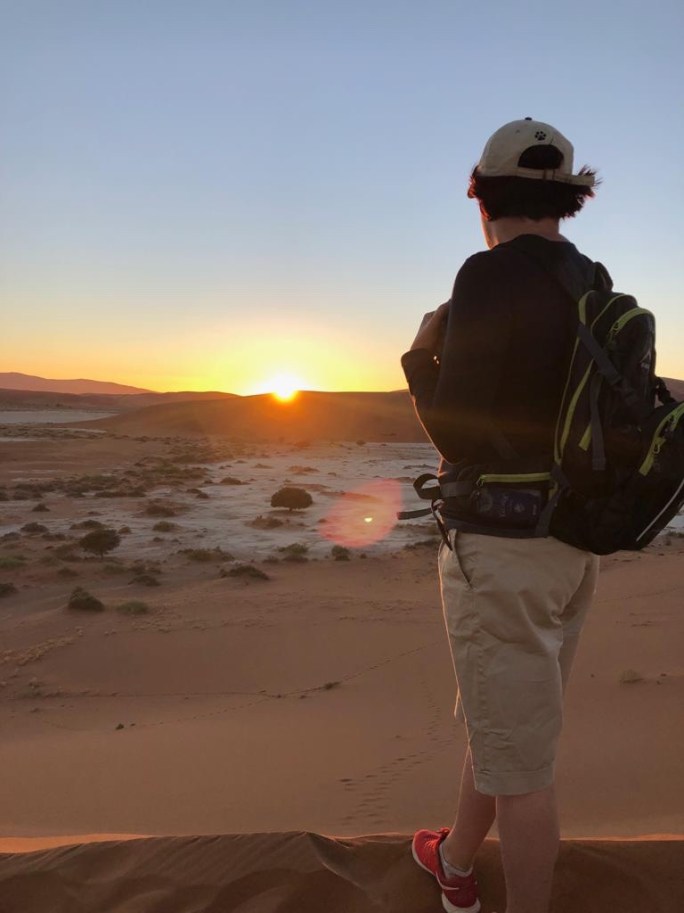
After the peaceful seclusion of Sterreprag, Sesriem campsite was quite a shock to the system. It is the hub for tour operators and overlanders…swarms of them. I felt my enochlophobia kick in. Mercifully, it was only for one night. There is an advantage to staying there, though- you get an hour’s head start to Sossusvlei in the morning, so you can climb the dunes at sunrise before the hordes descend- or ascend in this case.
Going down was much easier:
After emptying a dune of sand from our shoes, we packed up and headed for Swakopmund. There was an essential pit stop in Solitaire for their apparently world-renowned apple tart. Clearly apple tart is a big thing in this neck of the woods – a delicious cultural remnant of German colonisation.
Apfelkuchen schmeckt gut, ja!
And then the bone-shattering journey began…200 km short of Swakopmund we heard a strange sound and our hearts sank. Yep, another puncture. And so, in the searing heat and dust, we unpacked (yet again) the contents of the boot in order to access the spanner and the high lift jack.
All was going swimmingly at first…
…but then we hit a snag: the jack would not release. So there we stood, with the Jeep cocking its hind wheel in the air in an undignified fashion, trying to figure out the mechanics of the jack. Why wouldn’t it release, dammit? What to do, what to do? I suggested we “call a friend”. We phoned Stew. Ai, die ou ballies! All to no avail – no amount of cranking and fiddling would budge the stupid thing. Then, enter Hulk Hogan and Helga: two well-meaning but equally clueless German tourists, who stopped to try and assist us. I thought that he should just lift the car for us, but was hesitant to ask.
The next dramatis personae to enter the comic drama were a local sheep farmer and his dog. He took a look but also stood scratching his head.
Eventually, we used a regular scissor jack to release the high lift jack, and we were finally able to change the wheel. And so, after much dust, sweat and gevloek, we were on our way again.
Ever since buying a series of photographs of Kolmanskop at the Hout Bay market, I’ve wanted to visit this ghost town on the outskirts of Luderitz. I have a fascination with ruins – I love to imagine what life must have been like in their heyday. We visited Kolmanskop this morning. At its zenith, it was a testament to what can be achieved with lots of money and ingenuity.
It was quite incredible to see how those wealthy German diamond prospectors were able to recreate an almost hedonistic European lifestyle in the middle of the desert. Bear in mind, this was the early 1900s and there was absolutely no fresh water. A million litres of potable water was shipped from Cape Town to Luderitz every month to sustain the town. But don’t think that life was an arduous struggle for survival: they skimped on nothing. There was an ice factory, bakery, butchery and general supplies store which imported luxuries like Camembert cheese and salmon from Germany. Furthermore, to ensure that life was not dull, the quartermaster arranged for European opera singers to perform for the Kolmanskoppers. There was also a bowling alley, restaurant, casino (!), champagne room for the ladies and a whisky room for the gentlemen. A massive saltwater swimming pool, complete with diving board, was yet another indulgence in this bizarre European outpost in the African desert.
Mule-drawn train which delivered free daily supplies of water, ice and lemonade to each household.Gargantuan swimming pool.
Bowling Alley
Now, all that remains are derelict buildings filling with sand, slowly being reclaimed by the desert.
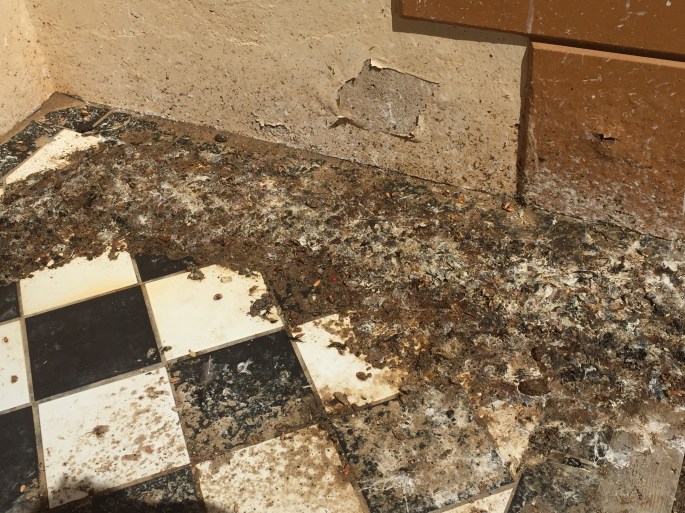
Originally a guano mining area, the deposits on the stairs of one of the former mansions suggests that the wheel is turning.
Road to our next stop: Sterreprag, a working farm a few kilometres outside Helmeringhausen
Sterreprag certainly lived up to its name. There was just a sliver of a moon and no artificial light for kilometres. The night sky was breathtaking. This is a troglodyte’s heaven: if quiet solitude is what you like, this is the place. It was just the two of us and a few cows.
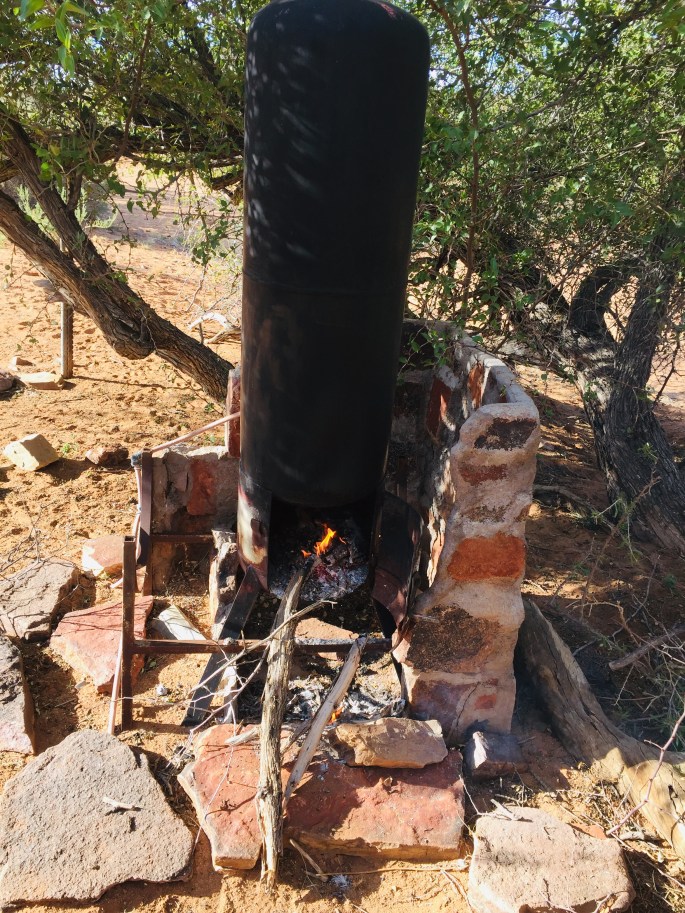
We lit the donkey…
“O die donkie, o die donkie, o die donkie is ‘n wonderlike ding”
…and, hey presto, we had hot water in the wilderness!
We may have been some of the last people to enjoy this secluded gem of a place as the owner has plans to develop self-catering chalets too. More’s the pity.
Next stop: Sesriem to camp and then up for sunrise over Sossusvlei.
We couldn’t resist the temptation of this delicious apple tart in Helmeringhausen.
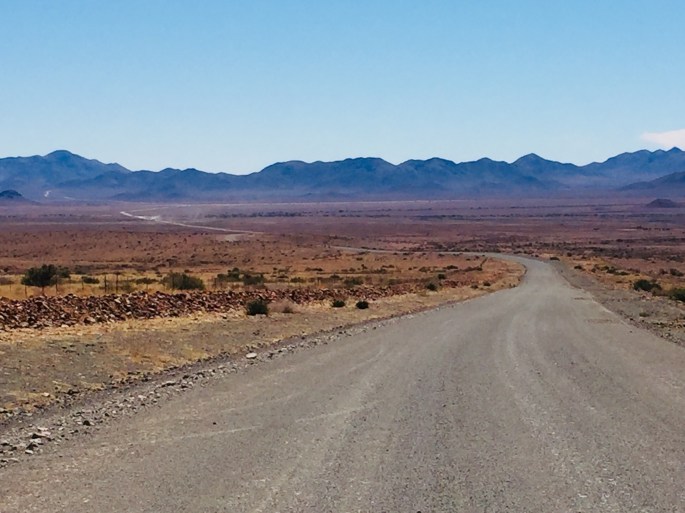
Today was another long day in the car, but the exquisite desert landscape and the interesting and unusual sights it offered made it an enjoyable drive.
Moer coffee at the back of beyond
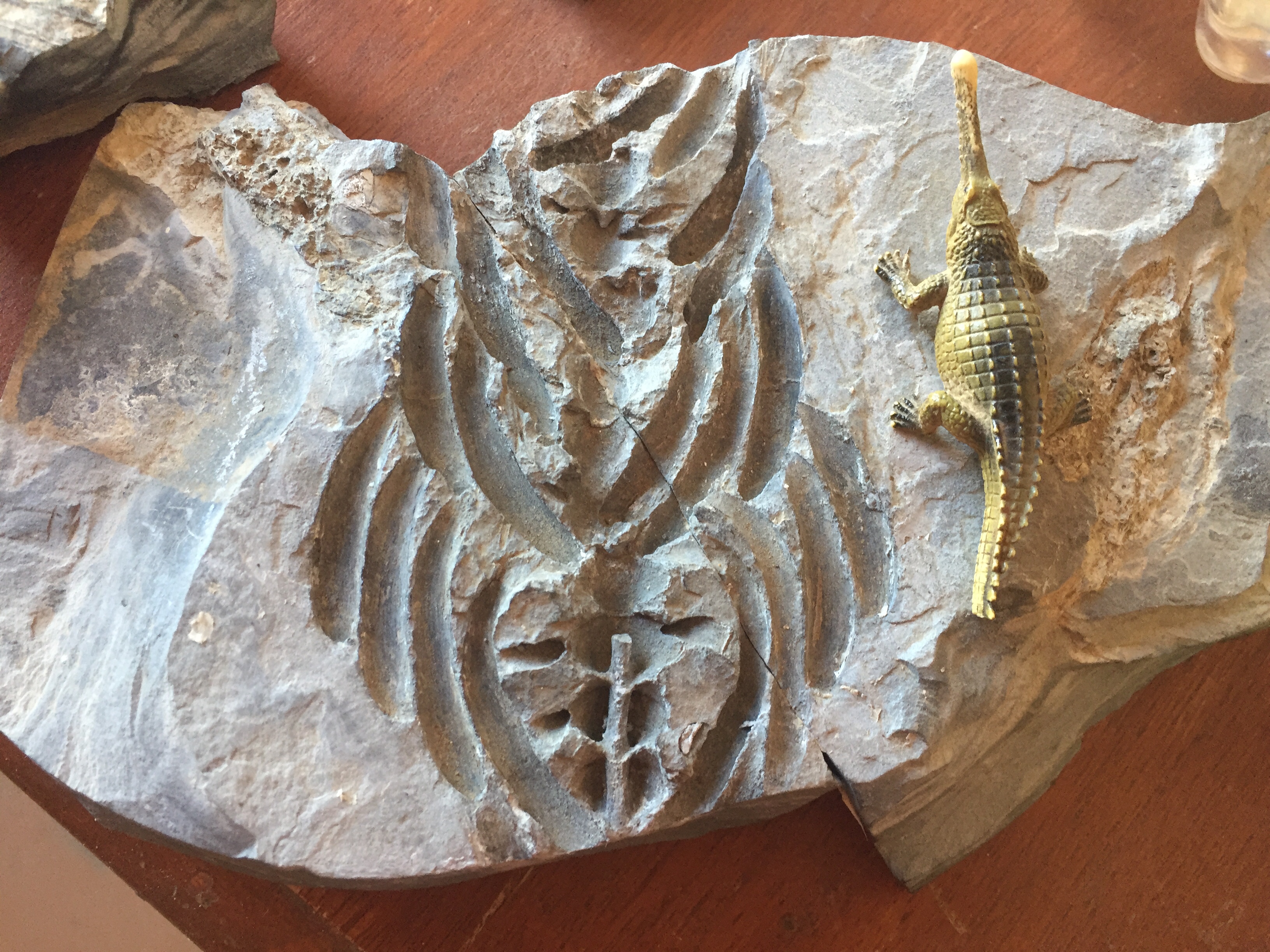
We stopped off at Mesosaurus Camp where Oom Giel Fosiel (really) entertained us with fascinating facts about the mesosaurus fossils found on his farm. This little amphibious creature became extinct some 250 million years ago. As I applied yet more lip ice to my chapped lips, it was hard to imagine this parched landscape being tropical at one point in its geological
Cast in stone 250 MYA, and in plastic in the last decade.
How much will the invention of plastic contribute to human extinction, I wonder?
In order to prevent power outages caused by sociable weavers’ nests built on power lines, separate poles have been provided for this purpose. Got me thinking: could we not entice Eskom officials to feather their nests elsewhere? Poles-moor, maybe?
I’ve seen plenty of biltong shops, maar wragtig, ‘n hele plaas?
Of course we stopped to replenish our dwindling supplies.
These horses (below) may look like your average farm horses, but this was actually a serendipitous sighting of the seldom-seen feral horses of the Namib. There are various theories about their origin, but colonists, from various countries, brought them here- and abandoned them.
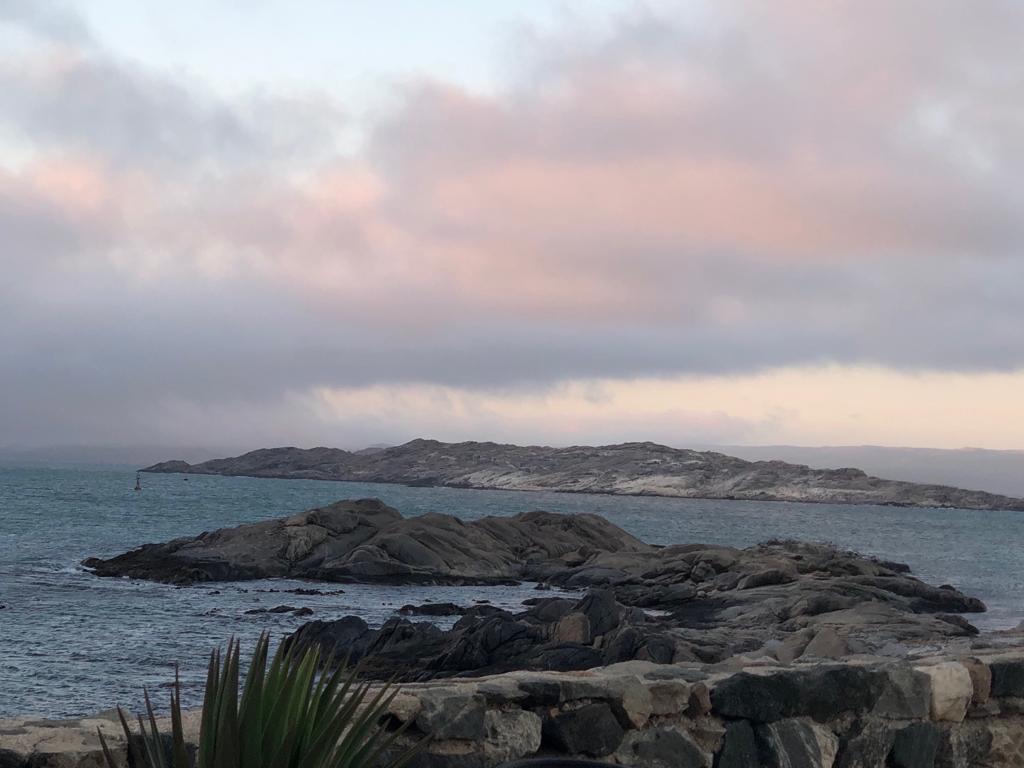
Our last stop was Shark Island where we spent the night. It is a beautiful, if windy, place to camp – with spectacular views of the Atlantic Ocean.
Travel Info:
1. The drive from Kalahari Game Lodge to Shark Island, Luderitz was 600km and took us 8 hours – including a two hour stop at Keetmanshoop for supplies and brunch.
2.Keetmanshoop:
1. For SIM cards, go to the “China” shop (in the same street as the information centre.
2. The Illy coffee shop has great coffee. It’s next door to the info centre.
3. There is a Pick n Pay and a Shoprite for supplies. There is a TOPS liquor store too. The butchery isn’t great.
4. BE VIGILANT. We learnt this the hard way when our spare cell phone was nicked out of our car while we packed a few groceries into the boot.
After a hot, blustery, grit-in-the-teeth kind of day, (great for getting laundry dried quickly, though!) the wind finally subsided at sunset.
“Sunrise, sunset – swiftly go the days”
Staying an extra day here allowed us to take a breather from life on the road. We’re now re-charged and ready for the next leg of the trip. Next stop, Keetmanshoop for provisions, and then on to Kolmanskop to camp.
Some travel tips so far:
1. If you’re intending to cross the border into Namibia at Mata Mata, you need to get your passport stamped at Tweerivieren. Remember to take your permit with you to the border post.
2. If you stay over at Nossob, don’t miss the hide and waterhole. It is lit up at night and seems to attract many animals. We had a spectacular sighting of a brown hyena there.
3. Pack lip ice and heel balm. It’s dry here!
4. Deflate tyres to at least 1.9 kPa for your own comfort and to prevent punctures.
5. Kalahari Game Lodge is a great place to stay. It is 16km from the border at Mata Mata. Campsites are private and facilities well maintained. There’s a beautifully cool swimming pool for some respite from the heat.























 Southern Safari 2